Parts of Southern Ontario To Ring In the New Year Buried in Up to 100cm of Additional Snow by Thursday

NOTE: YOU CAN CLICK ON THE MAP TO OPEN A ZOOMABLE IMAGE

The weather story this week has been dominated by intense snow squalls that have practically paralyzed areas east of Lake Huron and southeast of Georgian Bay, and this prolonged event is far from finished.

As of Tuesday evening, many roads across Huron, Perth, Grey, Bruce and Simcoe Counties have been closed due to dangerous whiteout conditions and rapidly accumulating snow. Springwater Township has even issued an emergency alert asking residents to stay off the roads entirely, citing the inability for emergency services to safely respond.

Unfortunately, the situation is expected to continue into the New Year as snow squall activity remains locked in across the region. Additional road closures are possible as squalls continue to drift and redevelop through Grey and Bruce Counties on Wednesday. Blowing snow will remain a major concern, even during brief lulls in snowfall, keeping travel extremely hazardous.

With snow squalls persisting and slowly shifting over the next 48 hours, widespread snowfall totals east of Lake Huron are expected to range from 30 to 60cm by the end of Thursday. We continue to highlight a few high-impact pockets between Owen Sound and Goderich, including areas near Chatsworth, Wingham and Point Clark, where total snowfall could approach or even reach 100cm if the most intense bands remain locked in place.

Simcoe County will also continue to be affected on and off through Wednesday and Thursday. A narrow but intense zone that includes hard-hit Springwater Township, along with Wasaga Beach, Barrie and Angus, could pick up an additional 30 to 60cm of snow. Confidence is slightly lower here compared to Lake Huron, and some locations may underperform if the bands wobble, but significant impacts remain likely.

Late Wednesday into early Thursday morning, attention will also turn to Lake Ontario. A snow squall currently targeting upstate New York may drift northward into portions of Prince Edward County, including Picton. If this materializes, snowfall rates could quickly ramp up, leading to a fast 15 to 30cm of accumulation in just a few hours.

Snow squall activity is expected to continue into Friday, though the pattern begins to evolve. A more westerly flow later Thursday and Friday would favour the Bruce Peninsula, northern Simcoe County and Muskoka for continued lake effect snowfall.

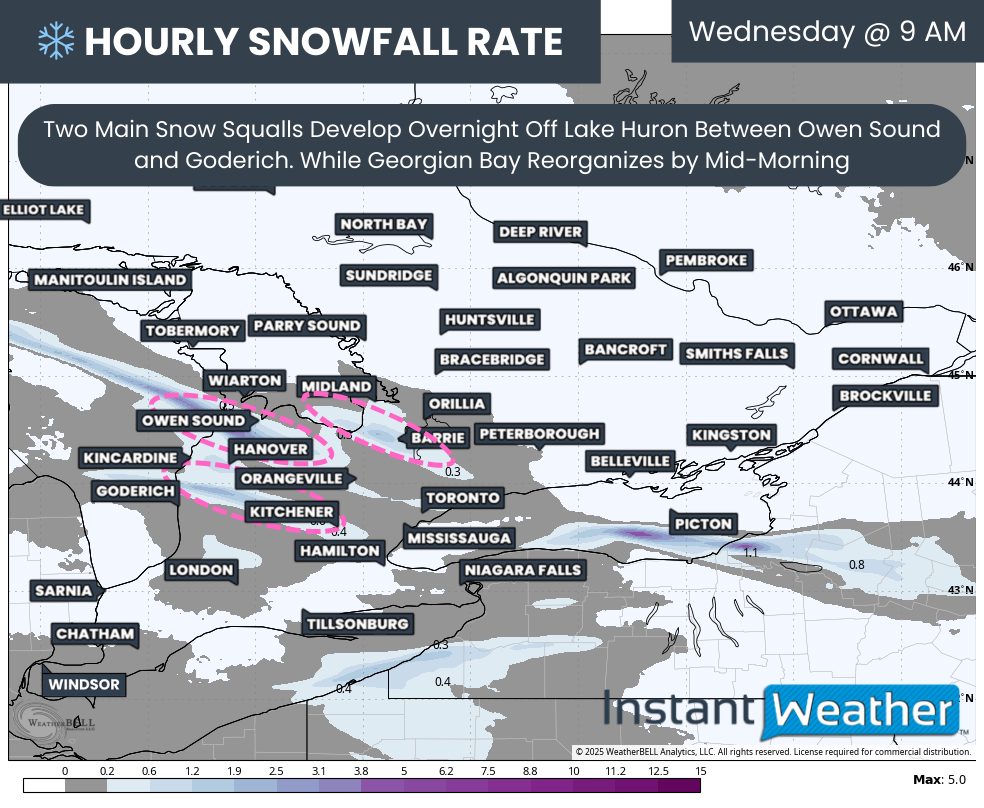
Hourly snowfall rates (cm) - MAP FROM WEATHERBELL

Overnight, snow squall activity is expected to consolidate into two primary bands between Owen Sound and Goderich. Meanwhile, activity off Georgian Bay may briefly weaken overnight, although confidence in that outcome remains low. Radar trends continue to show a very robust squall set up between Orillia and Barrie, and even if it temporarily diminishes, it is expected to redevelop by mid-morning Wednesday.

The southern Lake Huron squall may also stretch farther inland at times, potentially reaching areas like Kitchener and parts of the western GTA, bringing brief but intense bursts of snow and rapidly changing road conditions.

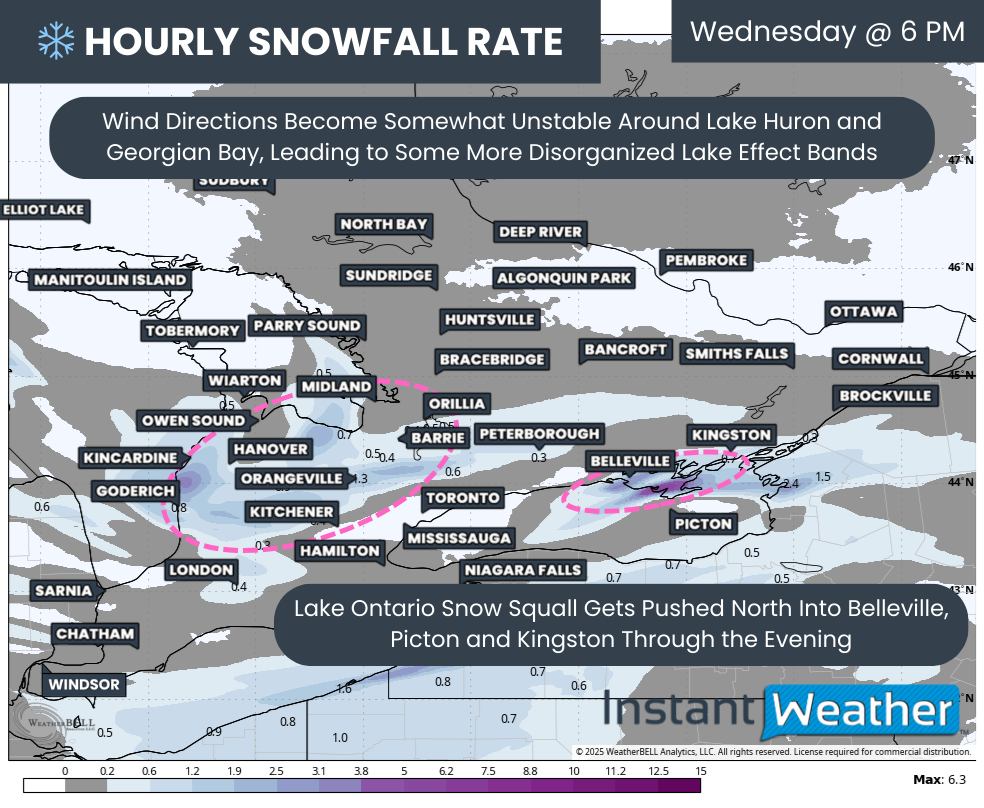
Hourly snowfall rates (cm) - MAP FROM WEATHERBELL

These squalls are expected to persist through Wednesday morning and afternoon. By Wednesday evening, a weak Alberta clipper will move through Southern Ontario, briefly shifting winds and causing lake effect snow to become more scattered for a time.

That same clipper will also cause a wind shift over Lake Ontario, which could push an organized snow squall northward into Belleville, Picton and possibly Kingston. Snowfall rates in this band could reach 4 to 8cm per hour, with total accumulations of 15 to 30cm possible before the squall exits around midnight.

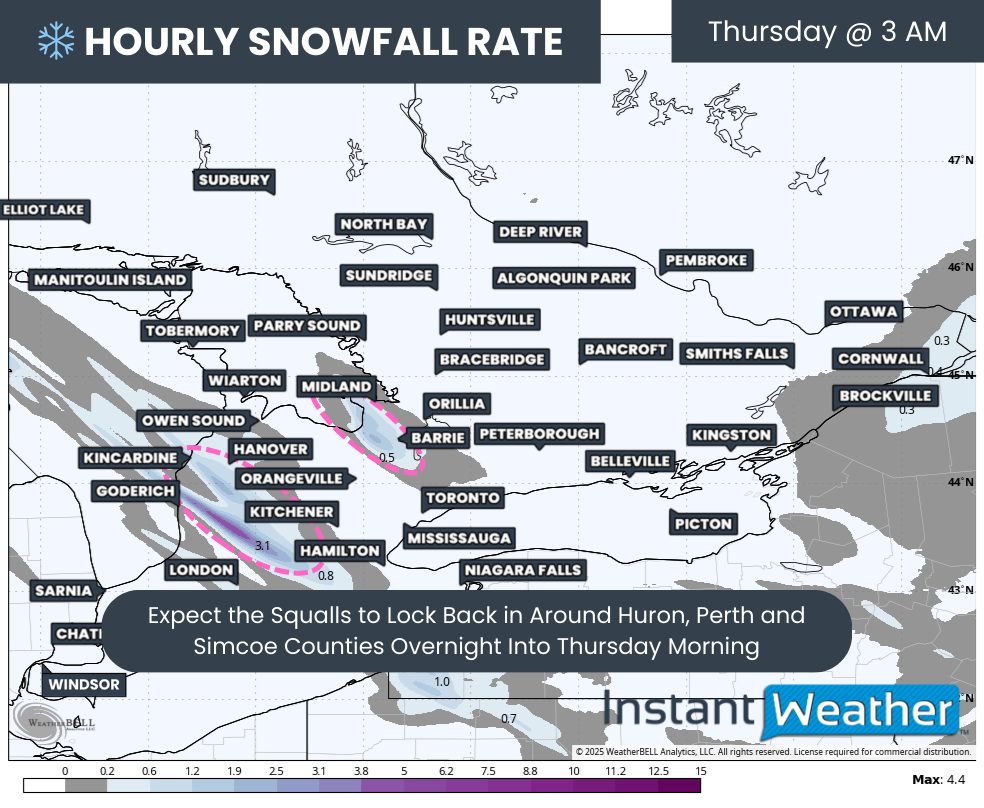
Hourly snowfall rates (cm) - MAP FROM WEATHERBELL

Snow squall activity should reorganize overnight into Thursday morning for regions east of Lake Huron and southeast of Georgian Bay as colder air deepens once again.

Based on the latest guidance, the strongest Lake Huron squall on Thursday looks most likely to set up somewhere near Kincardine, Wingham and Listowel, though this position could still shift. At the same time, the Georgian Bay squall is expected to continue hammering the Springwater and Barrie area.

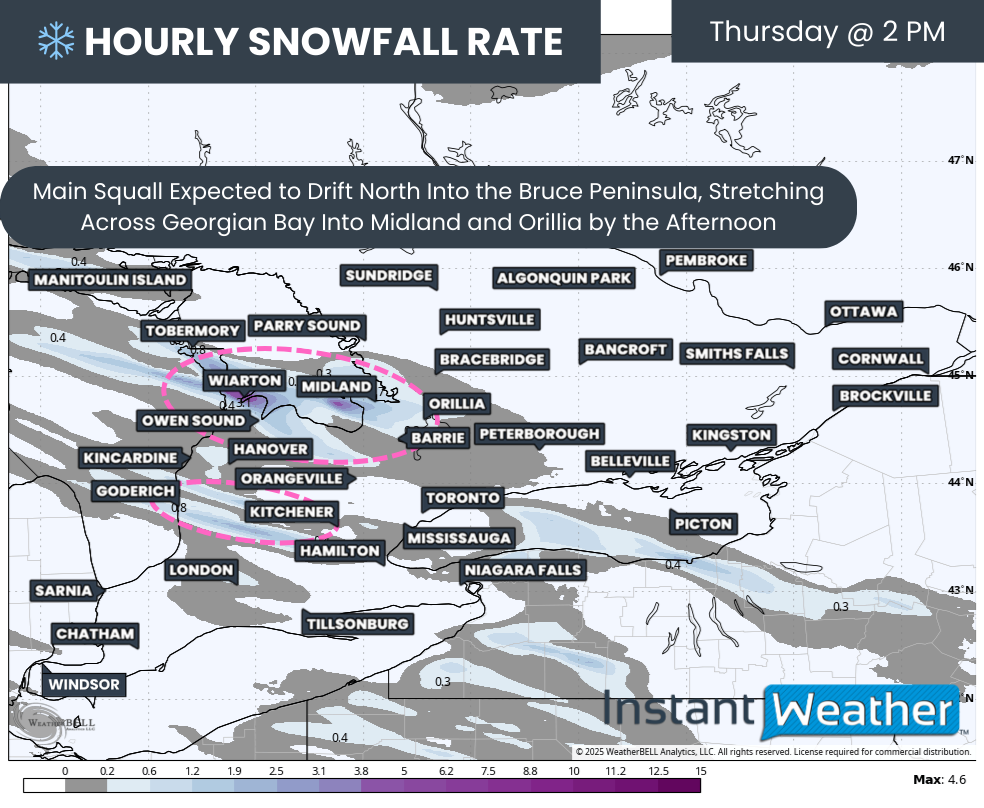
Hourly snowfall rates (cm) - MAP FROM WEATHERBELL

By Thursday afternoon, the focus may shift northward as a multi-lake squall develops, stretching across the Bruce Peninsula, over Georgian Bay and into Midland and Orillia. Additional weaker bands may linger farther south across Huron and Perth Counties, including areas like Goderich and Stratford.

Looking ahead to Thursday night into Friday morning, the Georgian Bay squall may intensify further as winds become more westerly. This would allow the band to push northward into southern Muskoka, where it could lock in for much of the day Friday. A separate forecast focusing on Friday and the weekend will be issued closer to that time.

NOTE: YOU CAN CLICK ON THE MAP TO OPEN A ZOOMABLE IMAGE

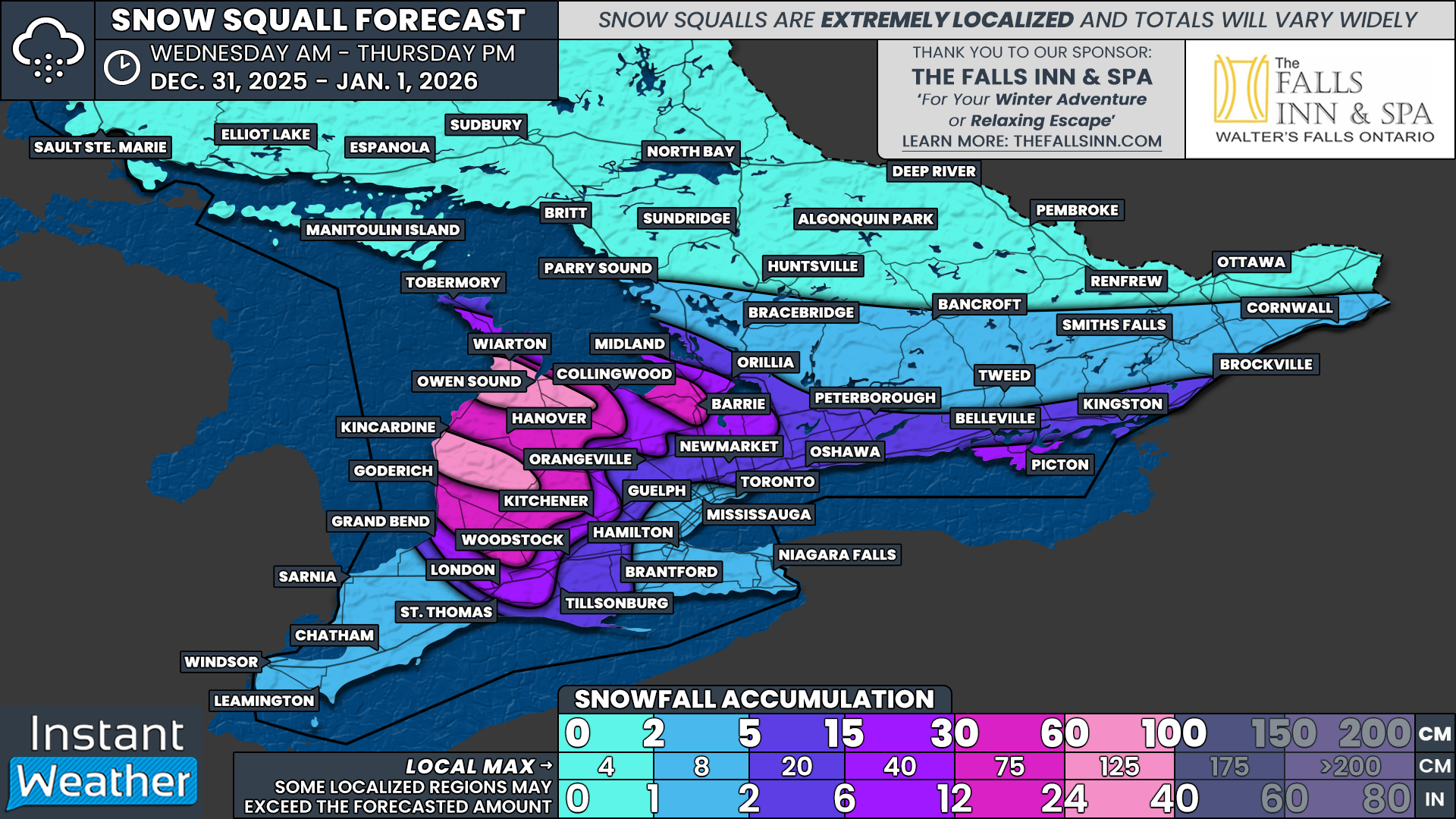
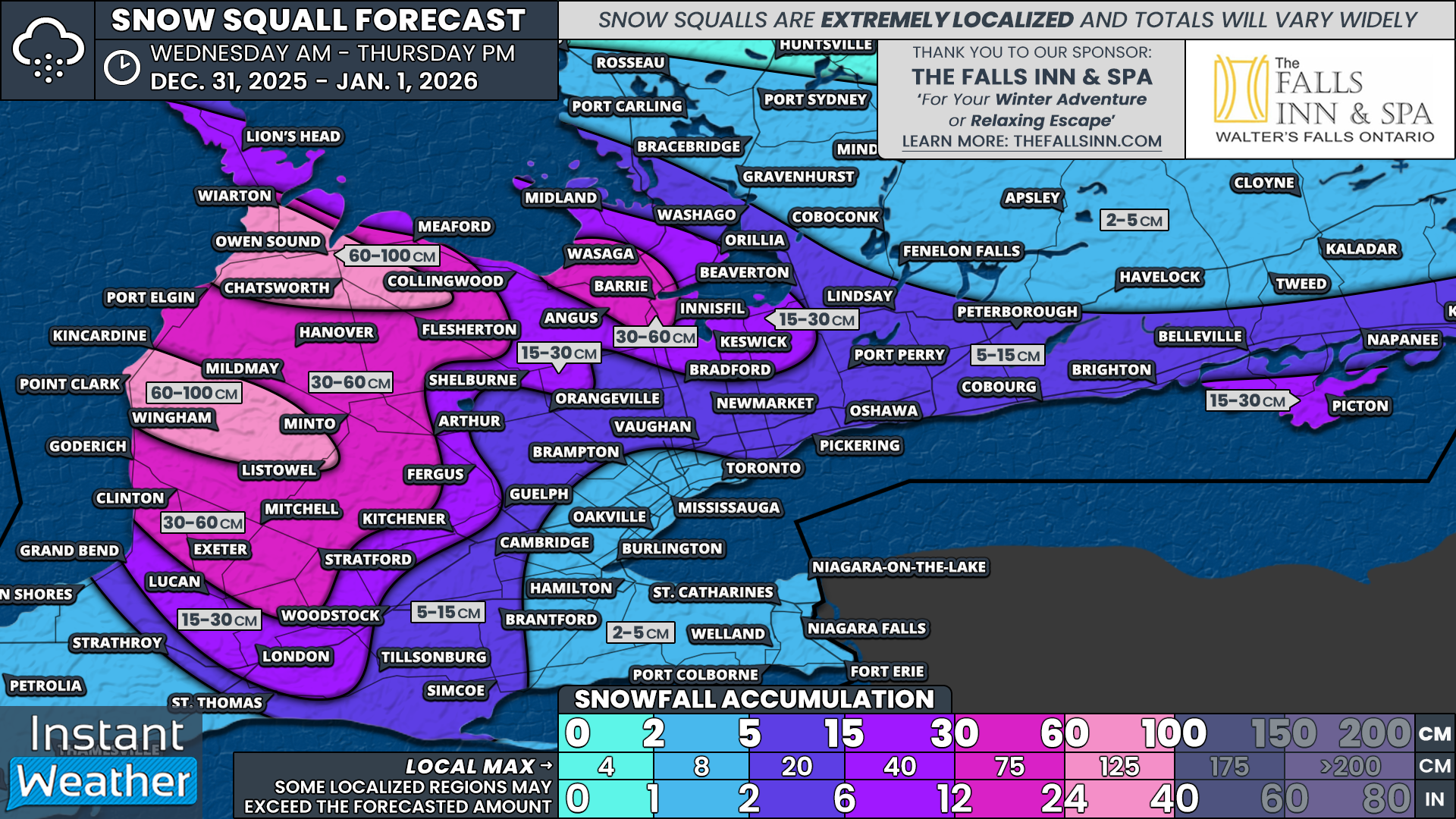
Before getting into final snowfall totals, it is important to remember that lake effect snow squalls are extremely localized. These narrow bands can produce massive snowfall in one community while areas just a few kilometres away receive very little. Forecast zones are intentionally broad to account for shifting winds and band placement, meaning not everyone within a zone will reach the listed totals.

With that in mind, there is strong model agreement on two primary zones with the highest snowfall potential ranging from 60 to 100cm, with localized amounts possibly exceeding 100cm if the most aggressive solutions verify.

The northern high-impact zone includes Owen Sound and Chatsworth, while the southern high-impact zone includes Point Clark and Wingham.

For the remainder of the eastern Lake Huron shoreline, snowfall totals of 30 to 60cm are expected, though isolated pockets could approach 75cm. Similar totals are possible from Wasaga Beach through Barrie, though totals there are more likely to remain on the lower end of the range.

Farther inland, areas including London, Woodstock, Kitchener, Fergus, Orillia, Innisfil, Keswick and Bradford could see 15 to 30cm. This is more conditional and depends on squalls stretching far enough inland in the right position.

That same 15 to 30cm potential also applies to parts of Prince Edward County, including Picton, where much of that snow could fall in a very short window Wednesday evening.

Surrounding regions extending southeast of London toward the Lake Erie shoreline, into Guelph, the north and eastern GTA, and along the Lake Ontario shoreline into Eastern Ontario could see 5 to 15cm by the end of Thursday. Most areas will likely stay closer to the lower end, though isolated pockets could approach 15cm due to intermittent lake effect bands.

The remainder of Southern Ontario, outside of northern Central and Eastern Ontario, can expect a general 2 to 5cm, mainly associated with the weak clipper system on Wednesday. Farther north, including the Ottawa Valley, less than 2cm is expected.

Weathering the Storm: How to Prepare For an Ice Storm

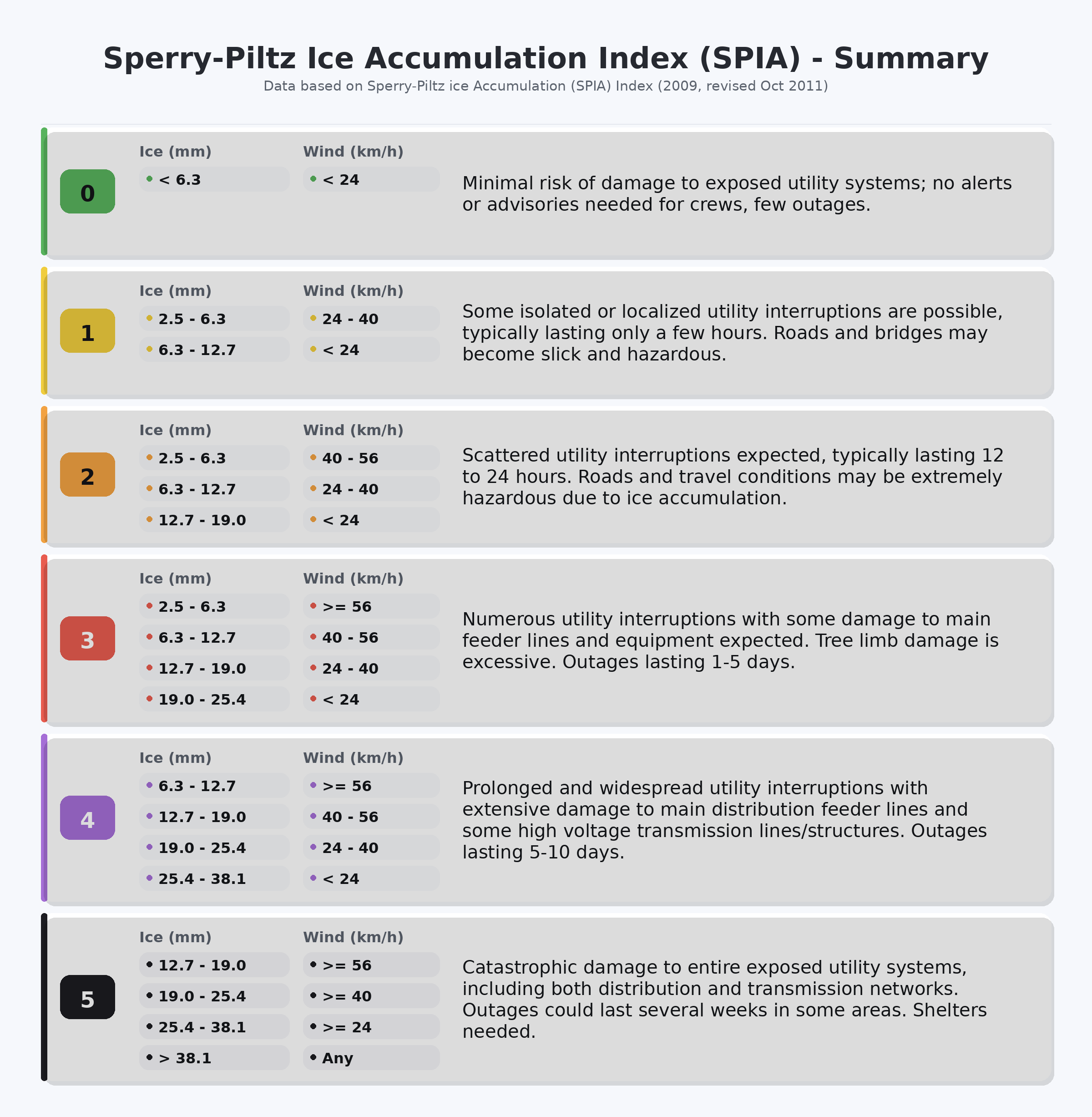
In advance of the ice storm anticipated to impact the province, we at Instant Weather want to make sure that everyone is ready in the event of potential widespread and long term power outages. The impact of an ice storm is not just dependent on the amount of ice accretion, but also the winds associated with the storm. This is summarized using the Sperry-Piltz Ice Accumulation (SPIA) Index shown below.

It is important to be prepared for these situations so we have put together a list of items you should have on hand in case of an emergency:

  • Flashlight (windup or battery operated)

  • Radio (windup or battery operated)

  • Extra batteries

  • Portable cell phone charger

  • Water (2 litres per person per day)

  • Non-perishable canned or dried food

  • Manual can opener

  • Blankets

  • Candles and matches or lighters

  • First aid kit and any prescriptions/medical items

  • List of emergency numbers

  • Cash

  • Gasoline

Not sure what kind of food to have ready? Dried food like rice and pasta along with canned tuna can go a long way. Other items such as bread and granola bars are good for fibre and non-refrigerated fruits like bananas, oranges and apples help break up the high-sodium content found in dried foods. Another staple for many are storm chips. For water, an easy way to store a large amount is to fill a bathtub and use the water for drinking, cooking, and flushing toilets.

Since ice storms occur during the winter and early spring months, keeping warm is a major concern during extended power outages from ice storms. Electric baseboard heaters and space heaters will not work. However, natural gas furnaces will still work, but electrical components such as the blower, which forces the warm air through the vents, will not. There are some propane heaters that can be used indoors, but be careful because outdoor propane heaters produce carbon monoxide, making them very dangerous to use inside a home.

Another item worth adding to your emergency kit arsenal is a generator. Generators are available in a variety of sizes and capacities based on individual needs. There are a few things to consider when picking a generator: type, power and additional features.

There are home standby generators that are permanently in place and start up automatically when the power goes out. These units are large and can be quite expensive. There are also smaller, portable generators that either run strictly on gas or on either gas or propane (dual fuel). There is an added benefit of running your generator on propane as it less expensive to run.

Every generator has two power ratings: starting watts and running watts. In order to determine the power of generator you need, you first need to determine what appliances will be running. In the event of an emergency, you may find that the only necessities are the fridge and furnace fan.

It is EXTREMELY important to not run a generator in your house due to the risk of carbon monoxide poisoning.

With proper planning and preparation, everyone should be able to get through the stress that comes with extended periods without power. In the case of an ice storm, it’s important to stay indoors and reduce unnecessary travel. Also, we recommend not clogging up emergency lines with non-emergencies. Your power will be back before you know it!

End-of-Year Major Winter Storm to Bring Dangerous Ice Storm and Blizzard Conditions Across Southern and Northeastern Ontario Starting Sunday

Use Promo Code ‘Instant’ to Receive a Min. $25 Gift Card With Your Vacation!

NOTE: YOU CAN CLICK ON THE MAP TO OPEN A ZOOMABLE IMAGE

As we close out 2025, the final few days are shaping up to be very messy and potentially dangerous. A complex and powerful winter storm is expected to impact Ontario between Sunday and Monday, bringing ice storm conditions to a wide swath of Central, Eastern and Northeastern Ontario.

With significant and prolonged freezing rain expected, widespread and long-lasting power outages are likely in the hardest hit areas. Ice accretion of up to 20mm is possible, and unfortunately, the regions most at risk include many of the same areas that were hit hard by last March’s major ice storm. In some locations, the power grid remains fragile, which raises additional concern.

Further north, the story will shift to heavy snow across much of Northeastern Ontario. Long-lasting blizzard conditions are possible here, with snowfall totals potentially exceeding 50cm by the time the storm finally winds down on Tuesday.

This system will also bring the risk of severe wind gusts across both Southern and Northern Ontario on Monday. Areas closest to the shorelines of the Great Lakes will be at the greatest risk, with damaging wind gusts in excess of 90 km/h possible. There may even be some isolated pockets, mainly in the Niagara region, that approach 100 km/h.

Southwestern Ontario will be largely unaffected by the first phase of the storm. Temperatures here will rise steadily on Sunday, peaking in the double digits by late afternoon or evening. Rain will fall steadily through Sunday and into early Monday. However, conditions will change rapidly as temperatures plunge Monday morning, creating a potential flash freeze as all that rainfall quickly freezes on roads and other surfaces.

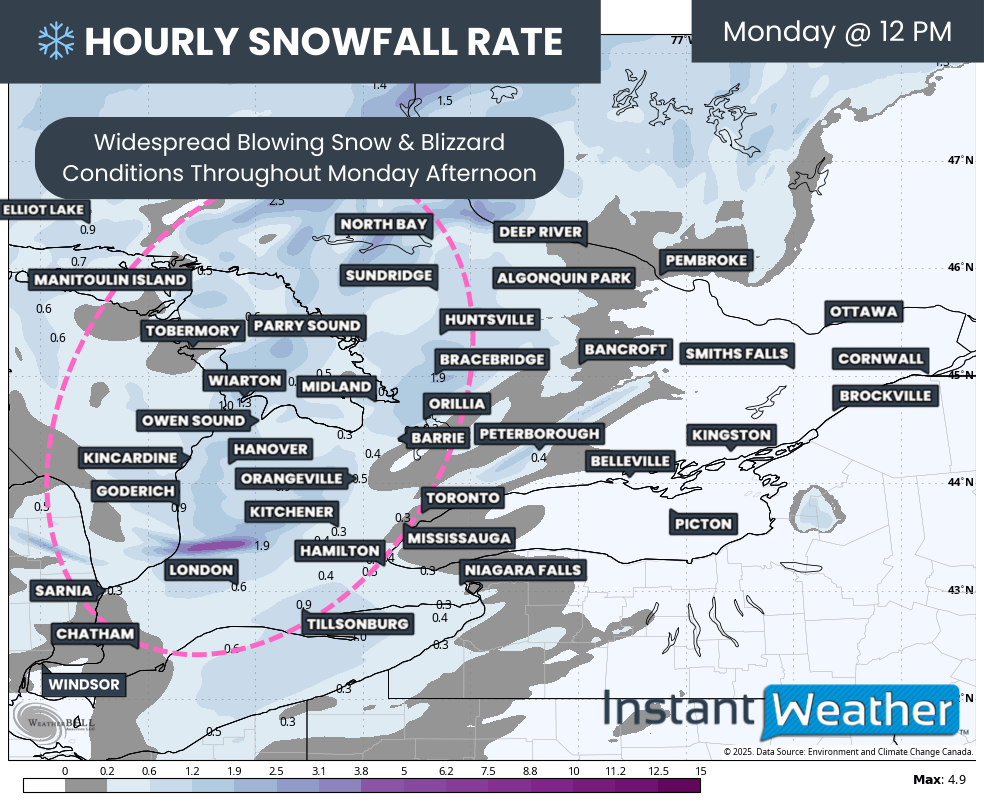
Later on Monday, strong wind gusts will combine with steady, moderate snowfall around Lake Huron and Georgian Bay. Blizzard conditions could develop during the afternoon and evening as visibility drops and blowing snow becomes intense.

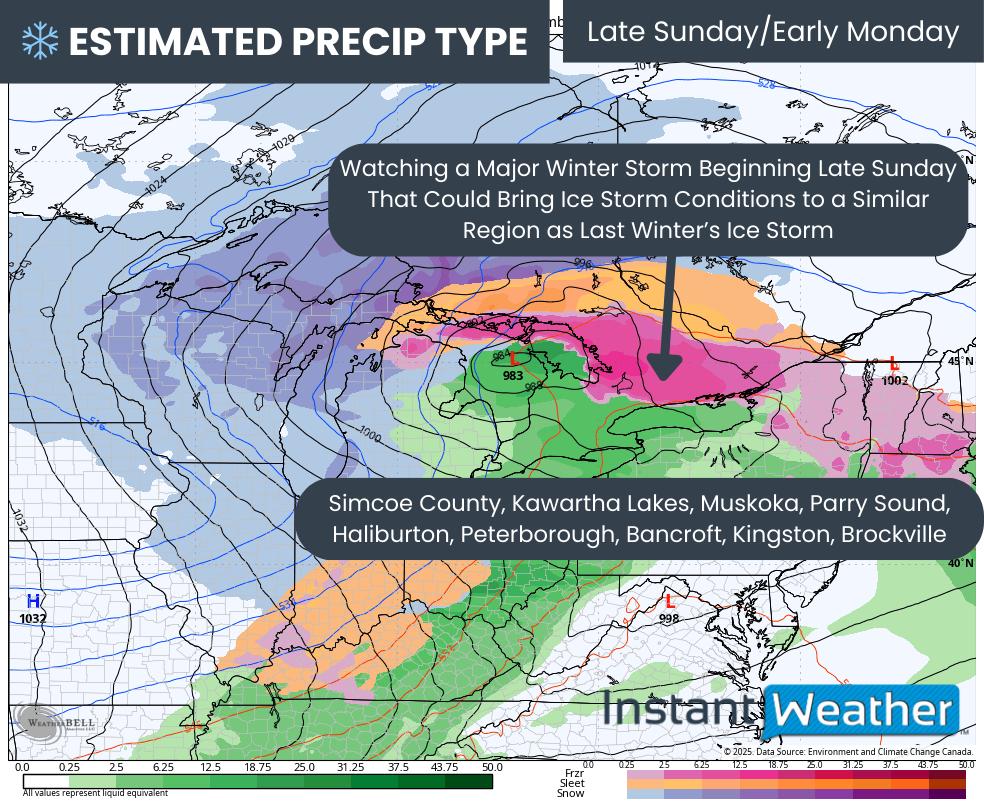
PRECIP TYPE - MAP FROM WEATHERBELL

The storm will begin to take shape late Sunday morning as the first bands of precipitation spread into Northeastern Ontario and parts of Southwestern Ontario. This will initially include some light freezing rain extending from London through Kitchener and Barrie.

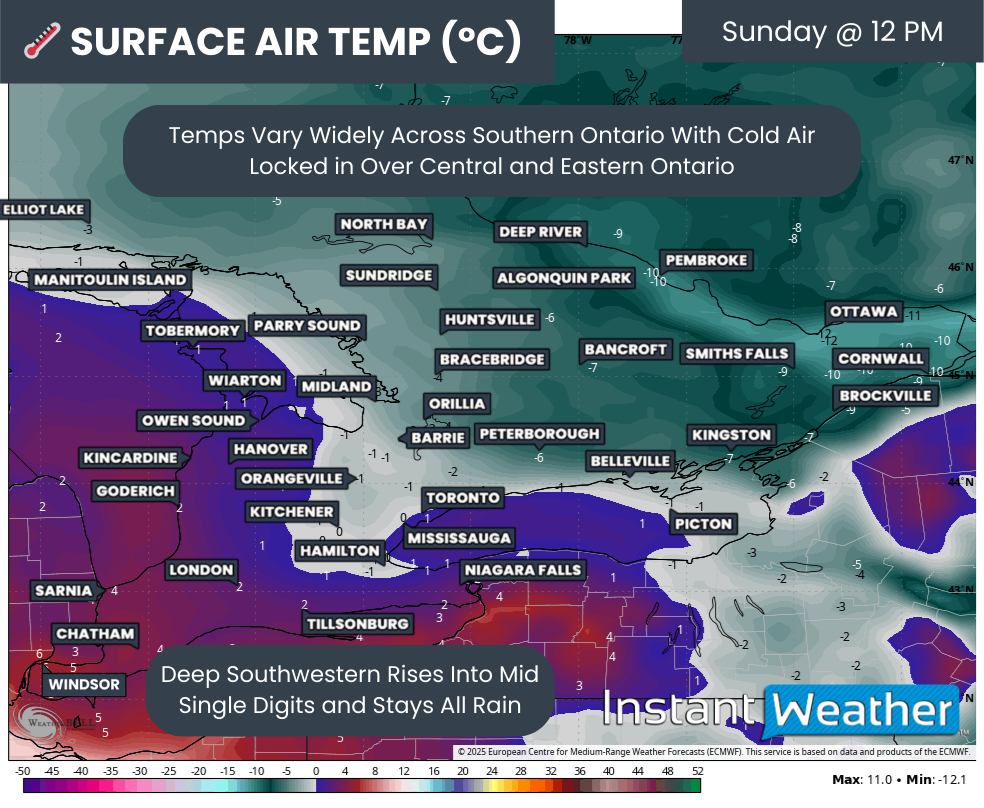
TEMPERATURE - MAP FROM WEATHERBELL

Sunday afternoon will be heavily dependent on the position of the freezing line, which is expected to slowly expand northeastward. Areas to the southwest will gradually climb above freezing and escape the worst of the icing, while regions farther northeast remain locked below zero.

By around midday, most of Central and Eastern Ontario is expected to remain well below freezing. Higher elevation areas northwest of the GTA will hover close to the freezing mark, including Hamilton, Kitchener, Guelph and Orangeville. How long the cold air remains trapped at the surface will play a major role in how impactful the icing becomes in places like the Kitchener area.

Meanwhile, Deep Southwestern Ontario, including Windsor, will already be sitting in the mid single digits. Heavy rain will be ongoing here, but there will be no winter storm impacts during the day on Sunday.

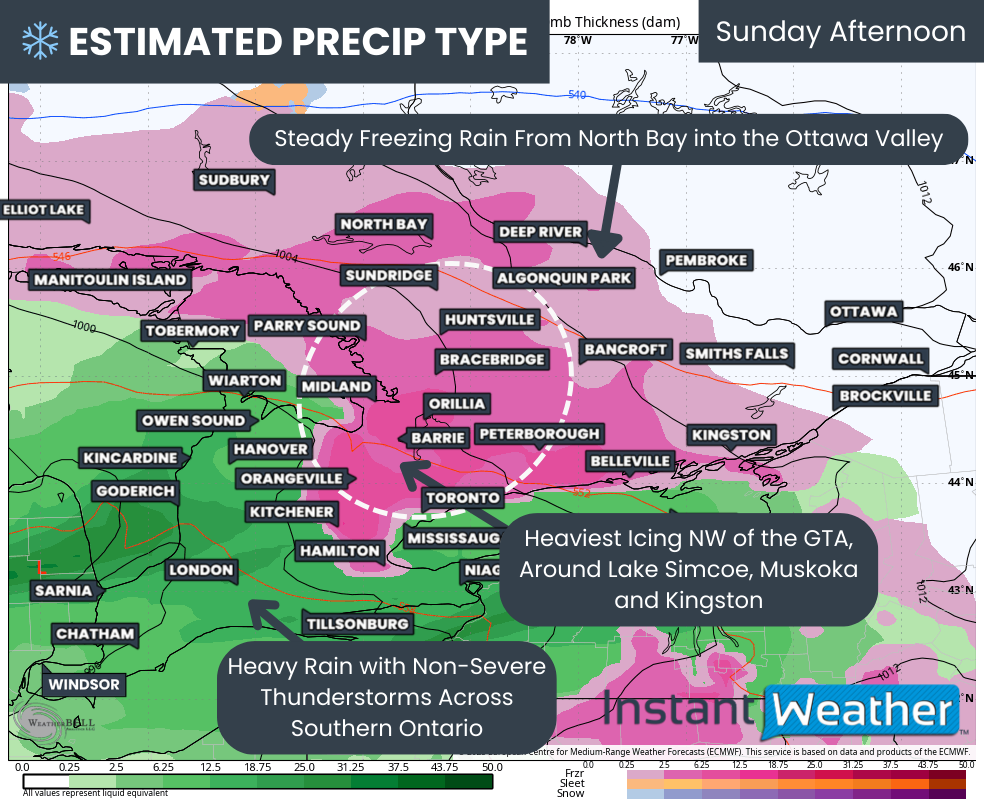
PRECIP TYPE - MAP FROM WEATHERBELL

As Sunday afternoon progresses, the freezing rain shield will expand northward into the North Bay area and the Ottawa Valley. The heaviest icing during this time is expected to focus around Lake Simcoe.

Locations such as Bracebridge, Lindsay, Orillia, Peterborough, Barrie, York Region, Kitchener and Orangeville appear likely to see the worst icing on Sunday afternoon. Precipitation rates will be quite heavy, allowing ice to accumulate rapidly on roads, trees and power lines.

At the same time, Southwestern Ontario, including the Niagara region, will see heavy rain, with some embedded non-severe thunderstorms possible. Rainfall totals could be significant, with some localized areas exceeding 50mm by Monday morning.

At the same time, Southwestern Ontario, including the Niagara region, will see heavy rain, with some embedded non-severe thunderstorms possible. Rainfall totals could be significant, with some localized areas exceeding 50mm by Monday morning.

Flooding could be a concern as frozen ground has a lower ability to absorb the rain.

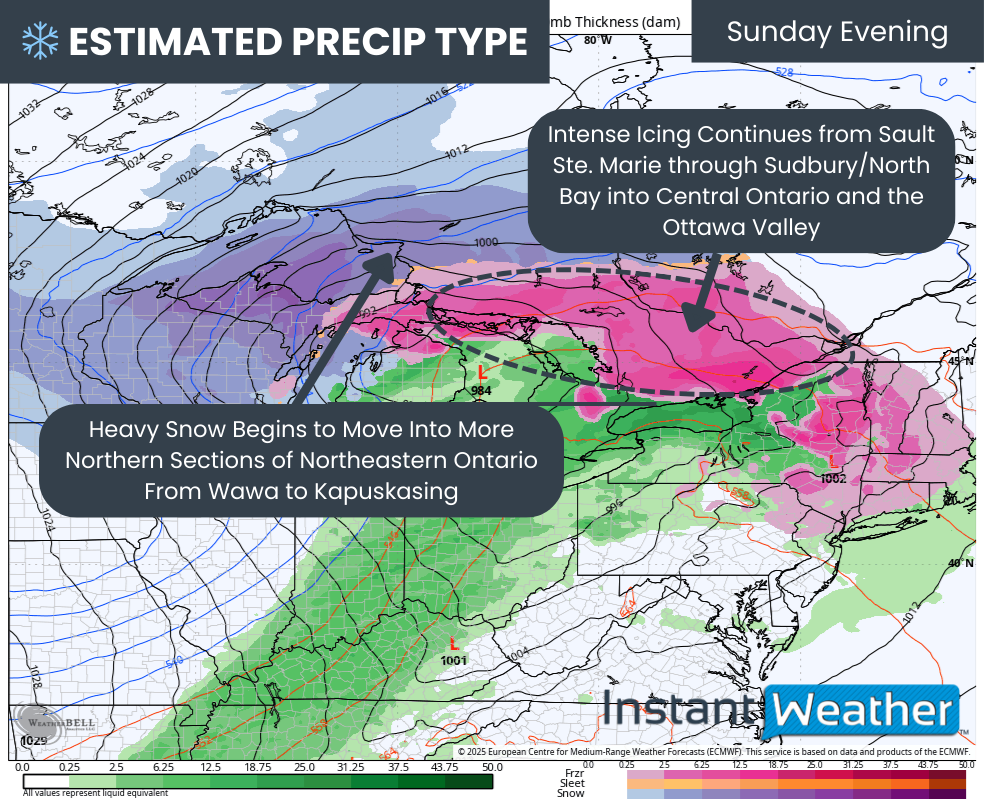
PRECIP TYPE - MAP FROM WEATHERBELL

As we move into Sunday evening, the freezing rain zone will become very expansive as the system rapidly intensifies. Intense icing is expected from Sault Ste. Marie through Sudbury and North Bay and into Central and Eastern Ontario.

Meanwhile, colder and more entrenched air across Northeastern Ontario will allow precipitation to switch over to heavy snow. Areas from Wawa to Kapuskasing will see snowfall rates increase significantly.

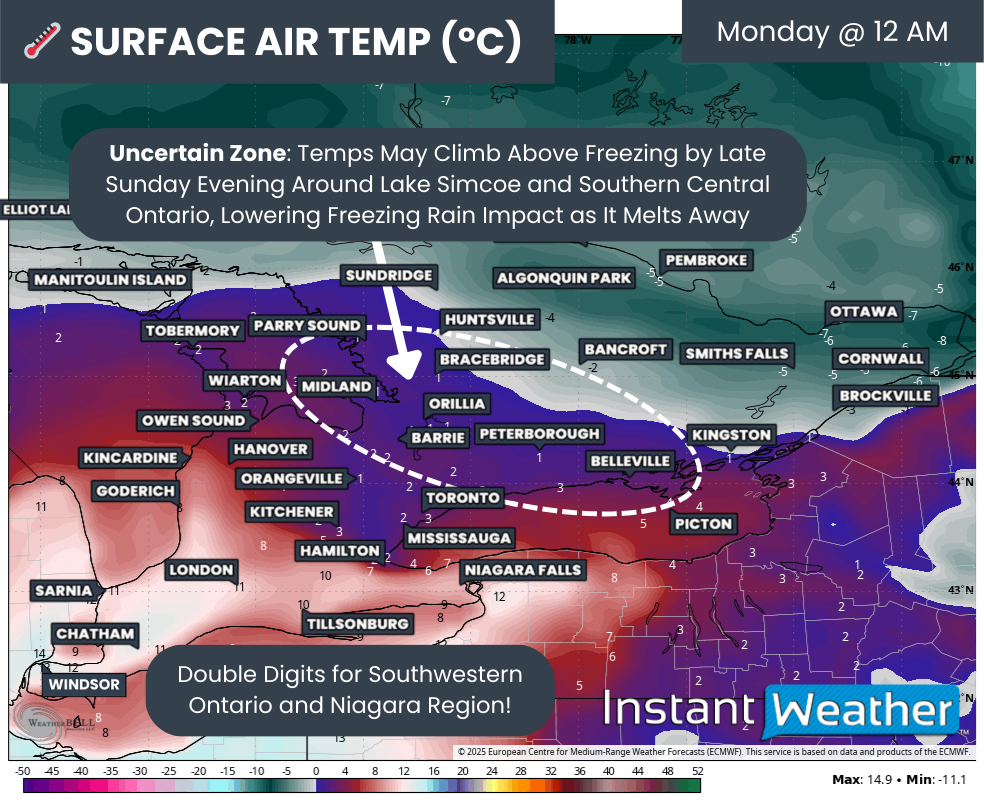
TEMPERATURE - MAP FROM WEATHERBELL

By late Sunday evening, uncertainty will increase across southern portions of Central and Eastern Ontario as temperatures hover very close to the freezing mark. This includes Barrie, Orillia, Muskoka, the Kawarthas, Peterborough and Kingston. If cold air proves even slightly more resilient than currently expected, these regions could remain below freezing overnight and continue to experience ice storm conditions.

In Deep Southwestern Ontario, it will feel almost surreal for late December, with temperatures climbing into the double digits even around midnight.

PRECIP TYPE - MAP FROM WEATHERBELL

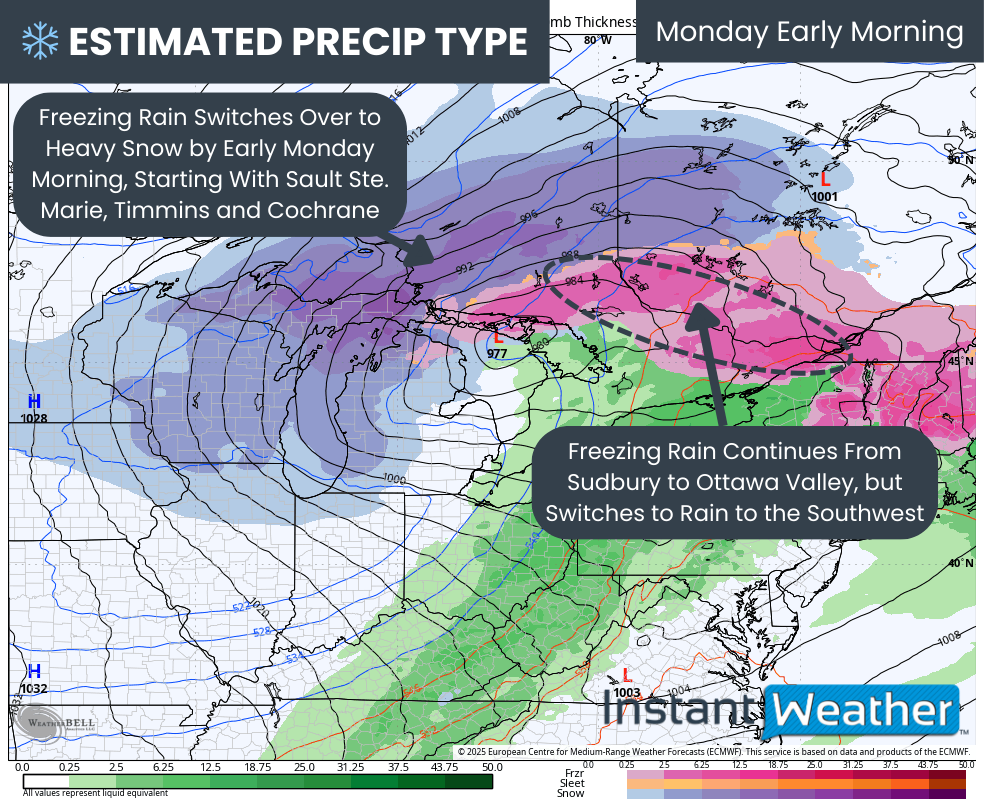
Overnight Sunday into early Monday, heavy snowfall will expand farther south across Northeastern Ontario as colder air continues to advance. Areas including Sault Ste. Marie, Timmins and the Cochrane corridor are expected to transition from freezing rain to heavy snow.

This transition is especially concerning for the power grid, as heavy snow may accumulate on top of ice-coated trees and power lines. That combination could lead to significant damage, particularly in more remote and heavily forested areas.

For the Sudbury to Ottawa Valley corridor, freezing rain is expected to continue through the overnight hours with ice accumulation steadily increasing. This region is likely to see some of the worst overall impacts due to the length of time spent under freezing rain.

TEMPERATURE - MAP FROM WEATHERBELL

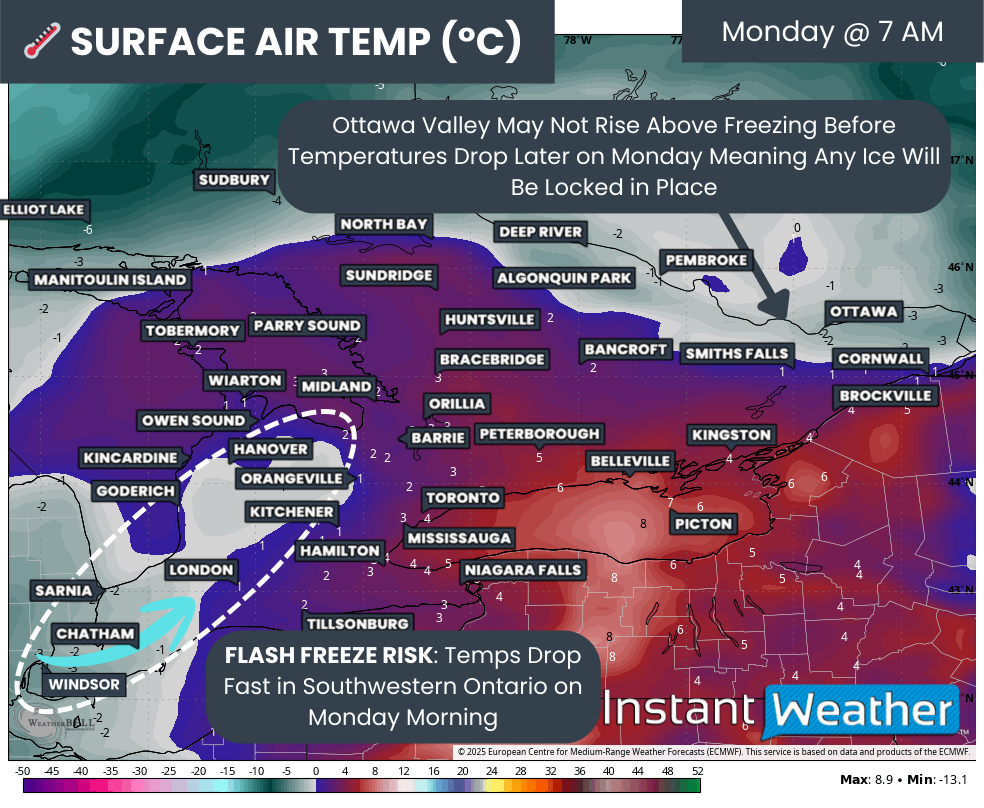
By late Monday morning, the next phase of the storm will unfold in the form of a flash freeze across Deep Southwestern Ontario. Rapidly falling temperatures will cause any remaining moisture to freeze quickly on untreated surfaces, creating extremely hazardous travel conditions.

NOTE: YOU CAN CLICK ON THE MAP TO OPEN A ZOOMABLE IMAGE

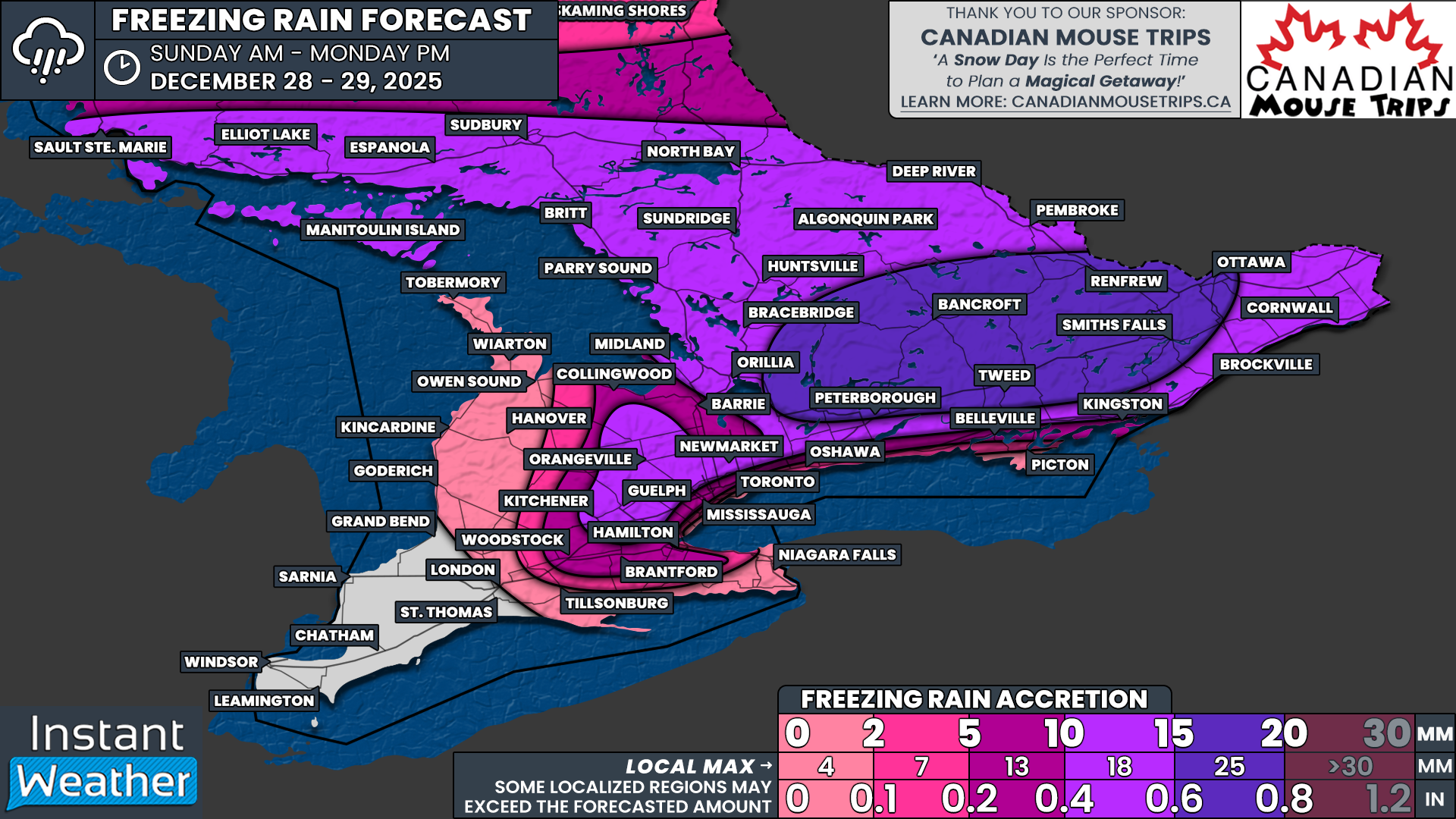
As freezing rain ends across Central and Eastern Ontario and temperatures drop by Monday afternoon, the true extent of the damage will become clear. Current data suggests the hardest hit areas may include Kawartha Lakes, Peterborough, Haliburton, Bancroft, Tweed, Kaladar, Renfrew, Perth and Ottawa. Ice accretion in these regions may range from 15 to 20mm, with localized pockets potentially approaching 25mm.

In the Ottawa Valley, temperatures may not rise above freezing at all before the flash freeze arrives. This would lock ice in place for an extended period, worsening impacts. Farther south, a brief window above freezing may help slightly reduce overall damage.

A broader area of Central and Eastern Ontario, along with higher elevations northwest of the GTA and parts of Northeastern Ontario, can expect between 10 and 15mm of ice. This includes Brockville, Kitchener, Guelph, Newmarket, Barrie, Muskoka, Parry Sound, North Bay, Sudbury and Sault Ste. Marie.

Ice amounts will decrease closer to Lake Ontario and away from higher terrain. Between 5 and 10mm is possible from Kingston through the northern GTA and higher elevations around Hamilton and Grimsby. Less than 5mm is expected for Oshawa, Mississauga, Hamilton and Meaford. Little to no icing is expected near Lake Huron and Lake Ontario, where temperatures remain above freezing for most of the event.

PRECIP TYPE - MAP FROM WEATHERBELL

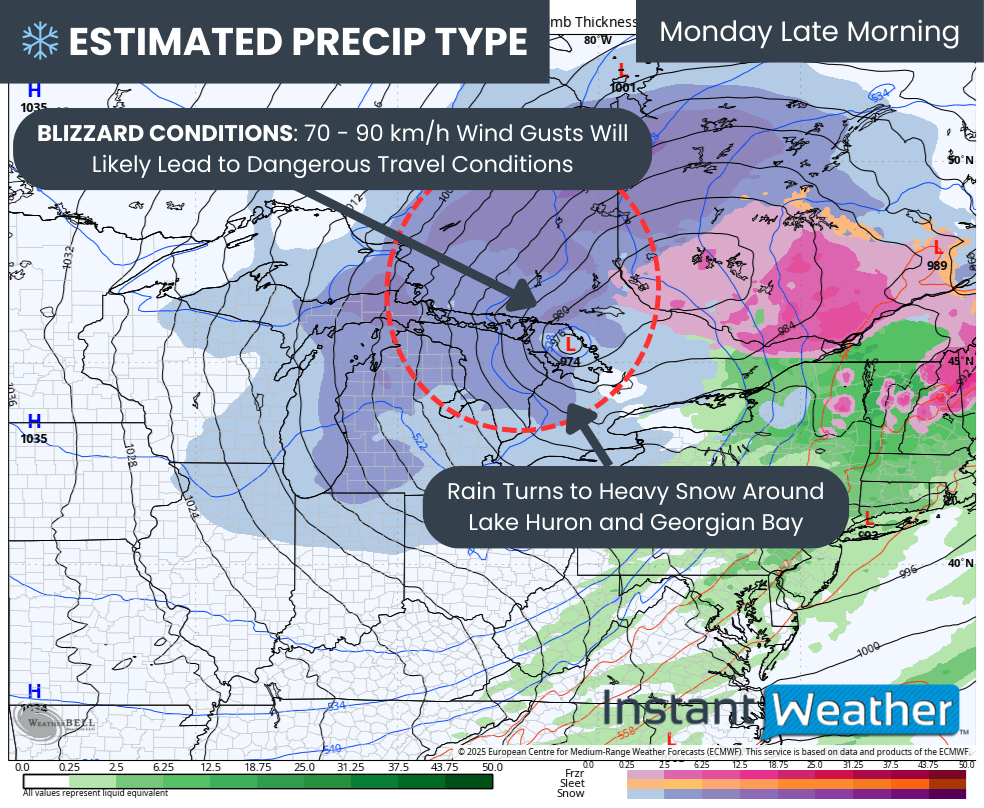
While freezing rain will end, hazardous conditions will continue. By late Monday morning, rain will change to heavy snow around Lake Huron and Georgian Bay. Strengthening winds of 70 to 90 km/h will create dangerous travel conditions and likely meet blizzard criteria.

Combined with the flash freeze, widespread road closures are likely east of Lake Huron and into Northeastern Ontario. Travel should be avoided in these regions.

NOTE: YOU CAN CLICK ON THE MAP TO OPEN A ZOOMABLE IMAGE

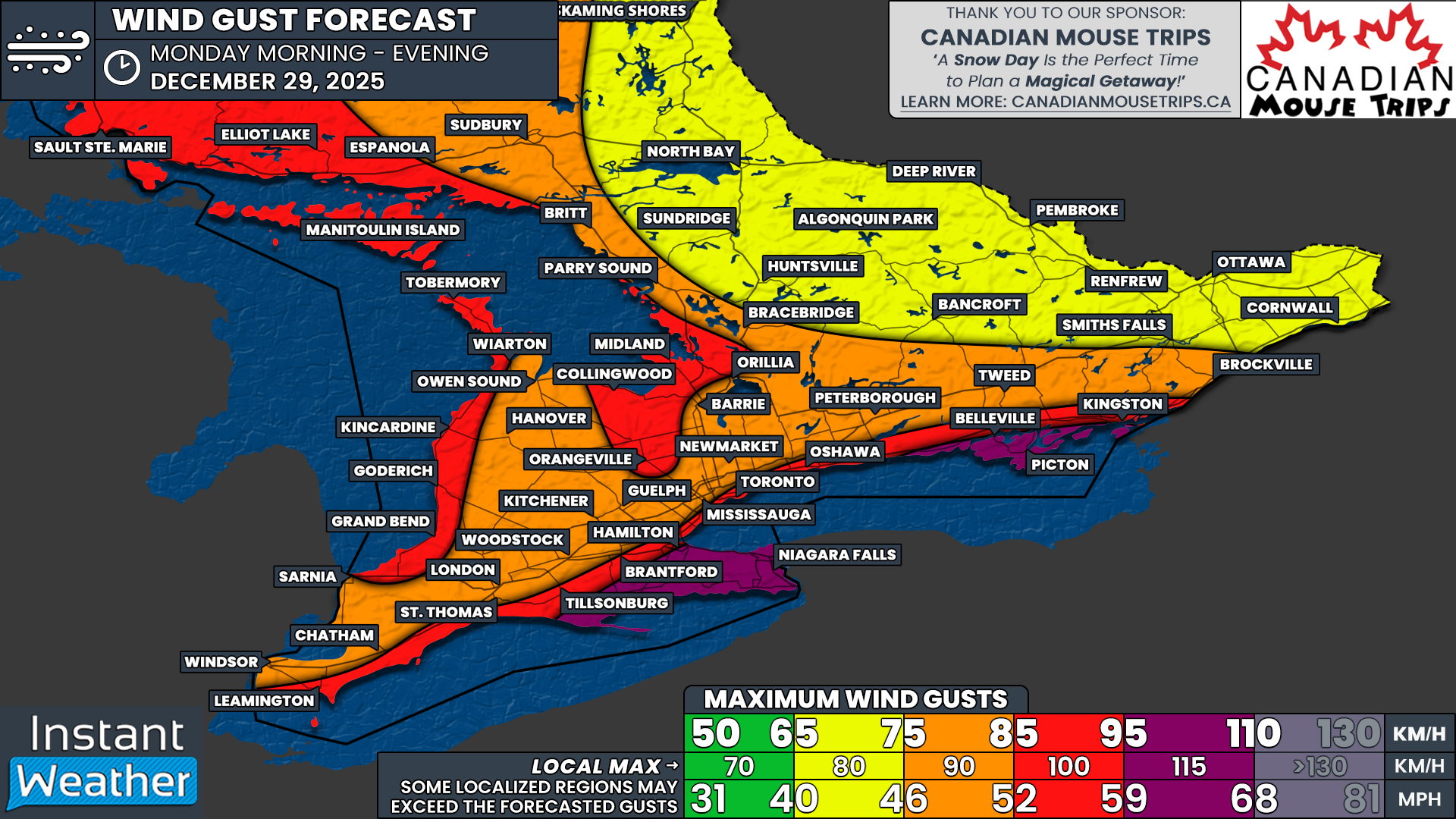
The strongest wind gusts are expected during the morning and afternoon on Monday before slowly easing in the evening. Areas exposed to the lakes will see the worst winds, with gusts of 95 to 110 km/h possible across the Niagara region and into Prince Edward County.

Near damaging gusts of 85 to 95 km/h are possible along the Lake Ontario shoreline from Kingston through the GTA and Hamilton, as well as along the Lake Erie and Lake Huron shorelines and southeast of Georgian Bay into Simcoe County and Orangeville.

Elsewhere across Southwestern Ontario and southern portions of Central and Eastern Ontario, peak gusts of 75 to 85 km/h are expected. Farther north, including the Ottawa Valley, gusts will generally range from 65 to 75 km/h. While lower, these winds may cause greater damage due to occurring after significant ice accumulation.

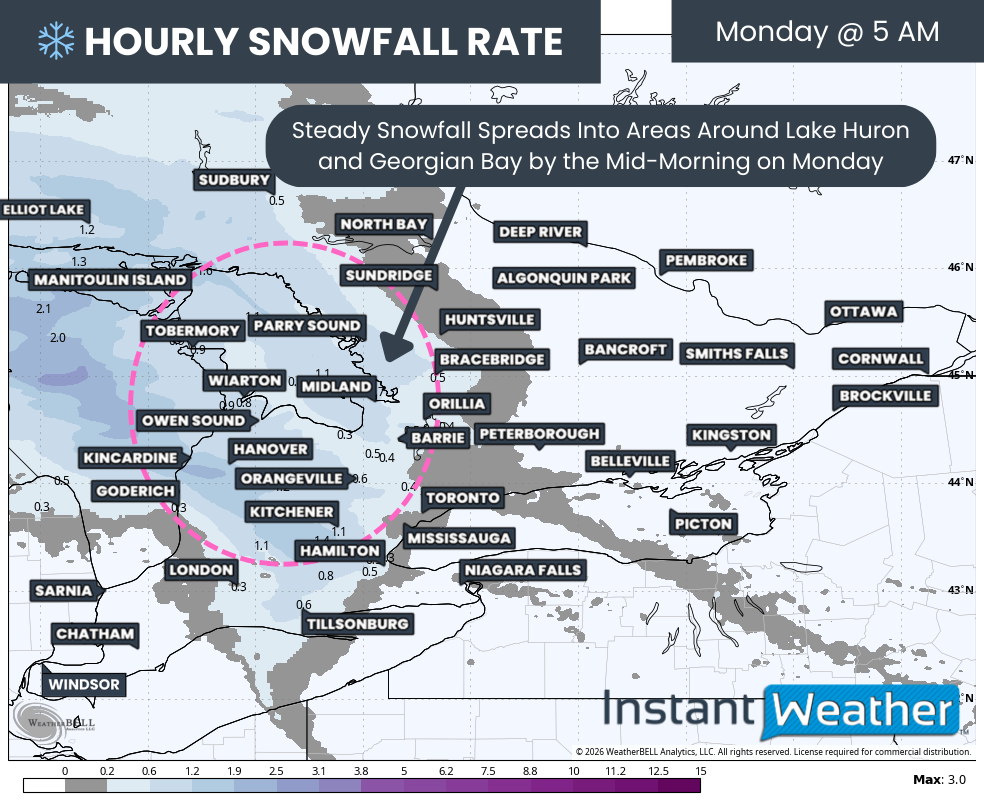
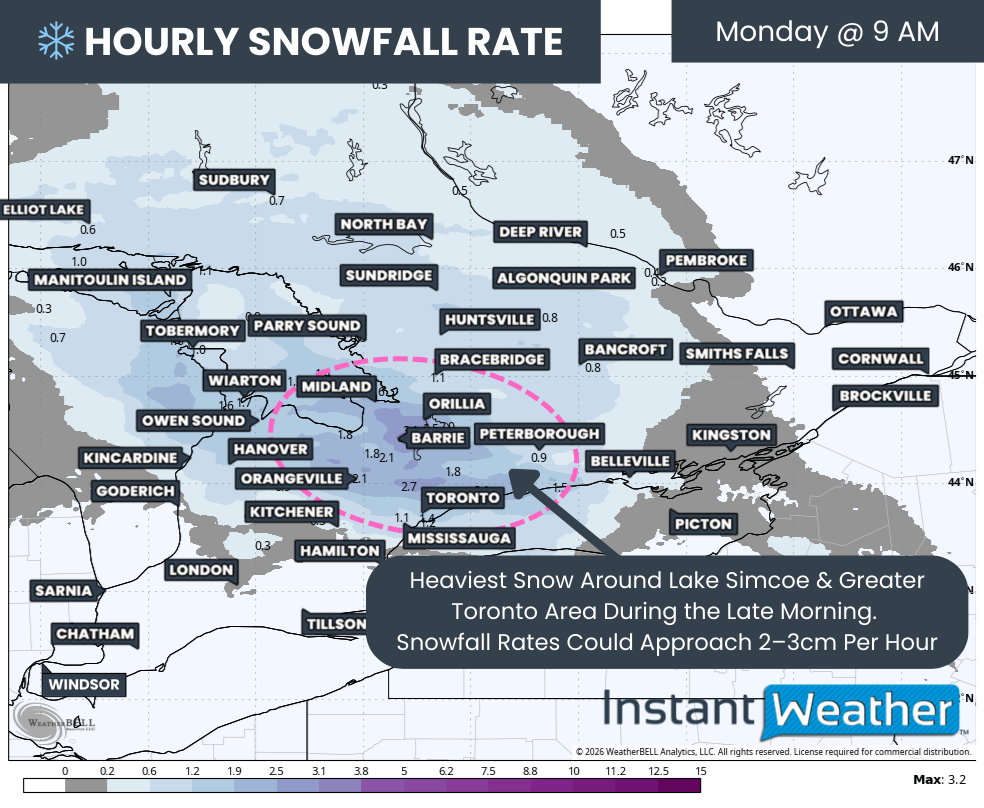
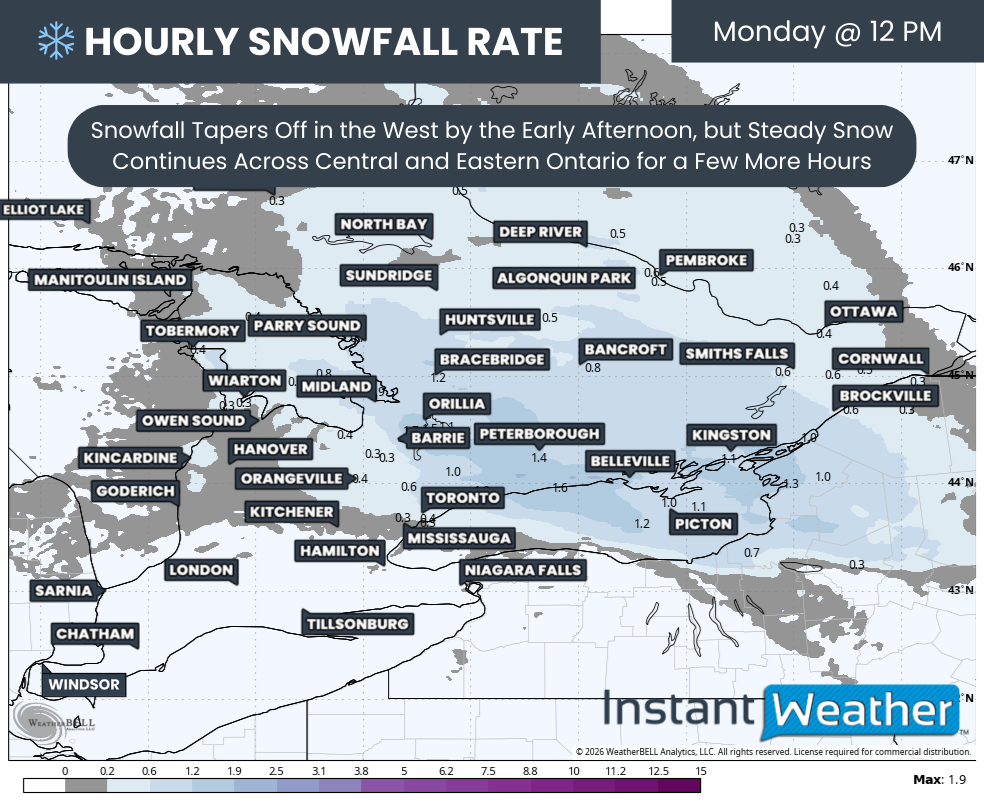
Hourly snowfall rates (cm) - MAP FROM WEATHERBELL

Conditions will remain treacherous through Monday afternoon with strong winds and persistent snowfall, especially near the lakes, where blizzard conditions continue.

NOTE: YOU CAN CLICK ON THE MAP TO OPEN A ZOOMABLE IMAGE

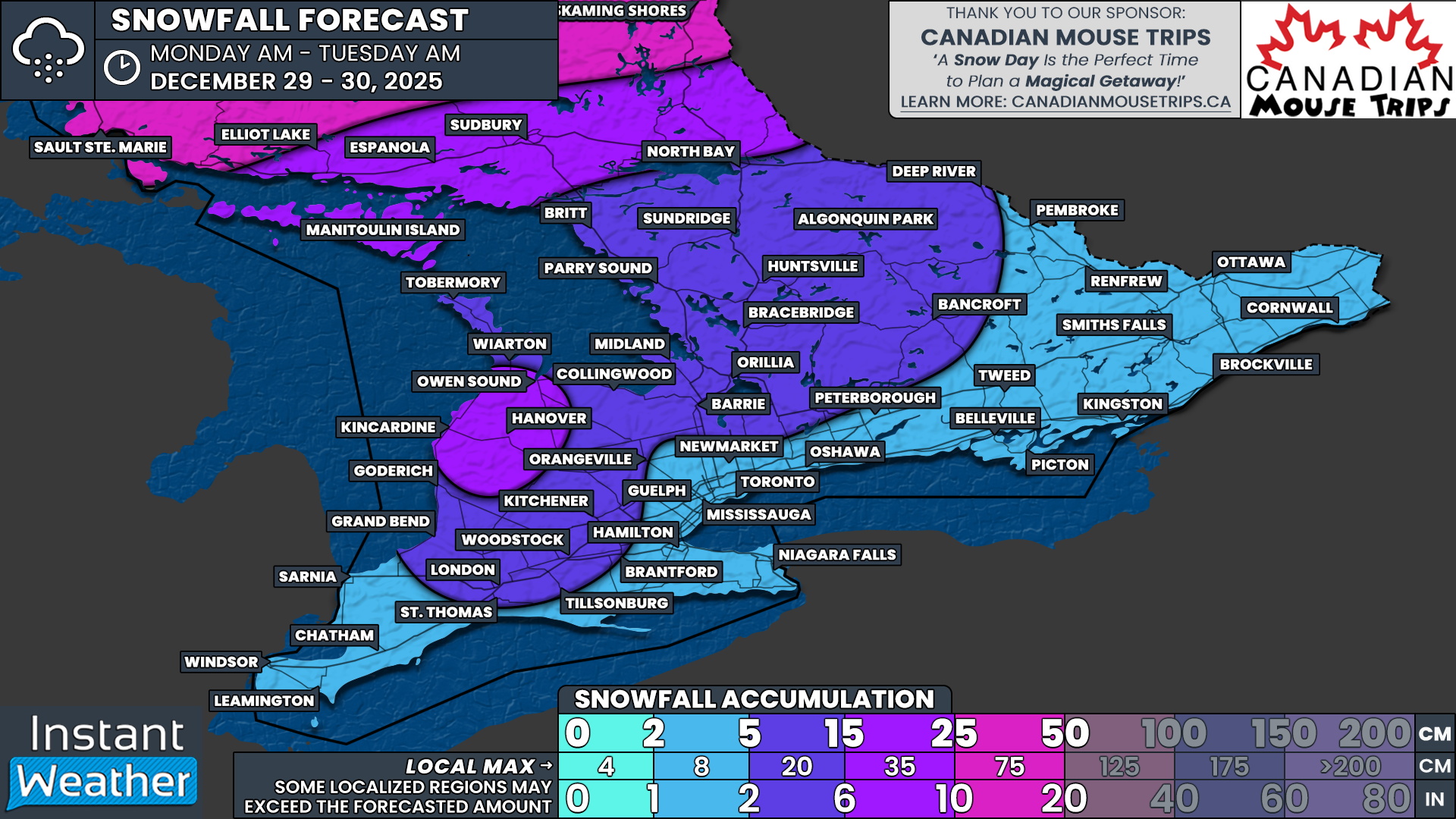
Snowfall totals associated with the main system will wrap up by Tuesday morning. Central Ontario and parts of Southwestern Ontario east of Lake Huron can expect 5 to 15cm of snow, with localized totals exceeding 15cm near Kincardine, Hanover and Owen Sound due to lake enhancement.

Elsewhere across Southern Ontario, snowfall amounts will generally range from 2 to 5cm.

NOTE: YOU CAN CLICK ON THE MAP TO OPEN A ZOOMABLE IMAGE

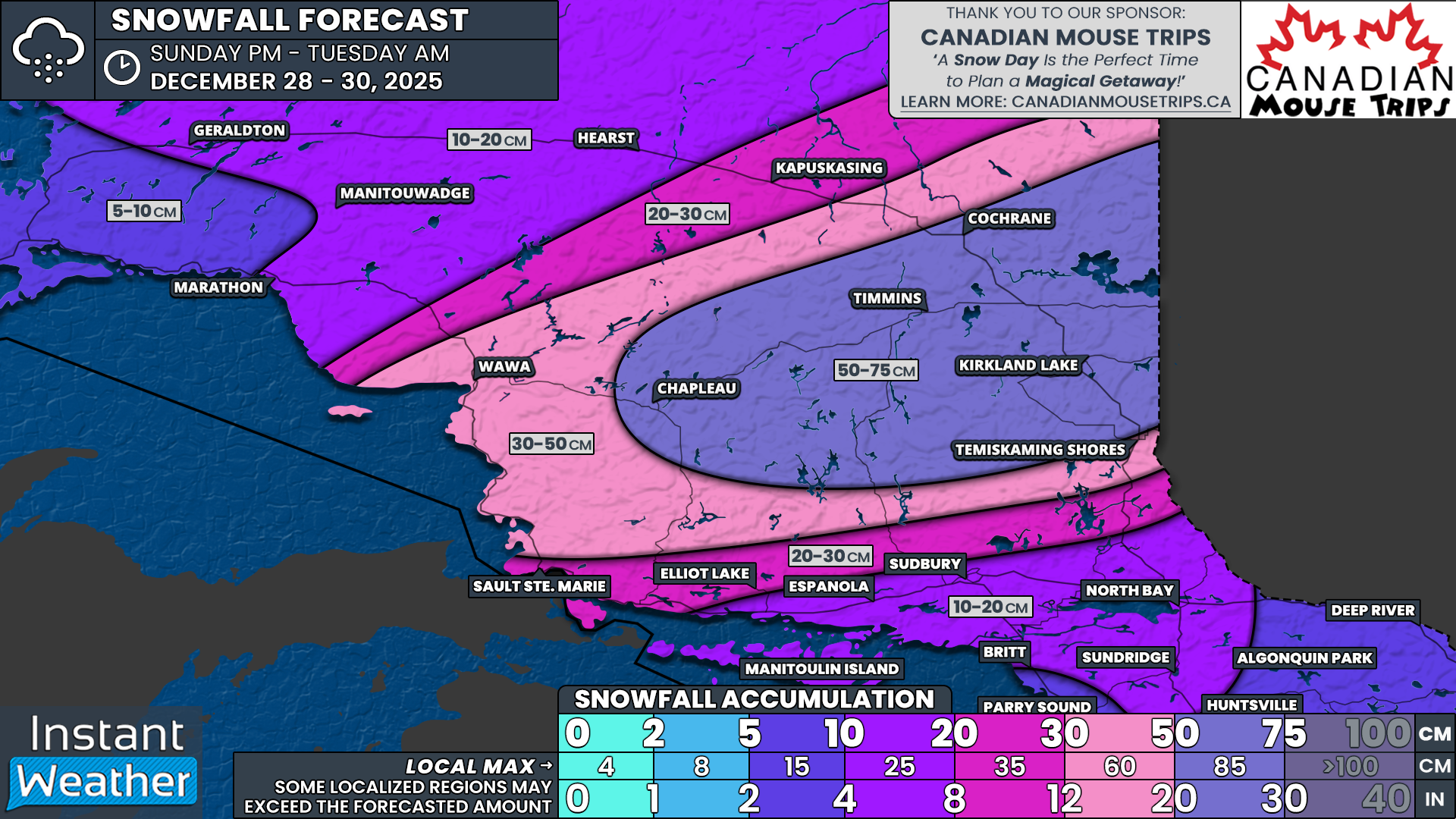
In Northern Ontario, snowfall totals will be far more significant. The highest amounts are expected in Cochrane, Timmins, Chapleau and Kirkland Lake, where totals of 50 to 75cm are possible between Sunday evening and Tuesday morning.

A broader swath of Northeastern Ontario, including Wawa and Temiskaming Shores, may see 30 to 50cm. Areas such as Elliot Lake, Sault Ste. Marie and Kapuskasing could receive 20 to 30cm, while North Bay, Sudbury and Manitoulin Island are expected to pick up between 10 and 20cm.

Boxing Day Winter Storm Poised to Deliver Ice Storm Risk and Heavy Snow to Southern Ontario on Friday

NOTE: YOU CAN CLICK ON THE MAP TO OPEN A ZOOMABLE IMAGE

With Christmas now behind us, the focus turns to the final stretch of 2025 as we approach New Year’s next Thursday. And it’s looking like the last seven days of the year will be anything but quiet when it comes to the weather across Southern Ontario.

That active pattern becomes clear very quickly with a looming Boxing Day winter storm expected to bring a messy mix of precipitation. Some areas will see periods of heavy snowfall, while others could be dealing with a potentially damaging ice storm with prolonged freezing rain through much of the day.

For much of Central Ontario, along with parts of the Golden Horseshoe and into portions of Southeastern Ontario, the primary concern will be snowfall. Widespread totals in the 10 to 20 cm range are possible by the end of Friday. The Ottawa Valley is expected to remain on the lower end, generally staying under the 10 cm mark.

The forecast becomes more complicated through Southwestern Ontario, extending through Hamilton and into the Niagara Region. Here, a mix of snow and ice pellets is expected, which will limit snowfall totals but still create hazardous travel conditions.

The freezing rain risk has shifted slightly northward in the latest model guidance, as warmer air aloft is now expected to push deeper into Southern Ontario than earlier projections suggested. This places the Sarnia to London corridor in the bullseye for the highest ice accretion. Freezing rain totals of 10 to 15 mm are possible, which could result in significant power outages and very icy road conditions.

Beyond Friday, attention is already turning to another slow-moving system expected to arrive Sunday and linger into Monday. This system appears to have access to much more moisture compared to Friday’s storm, raising the concern for a prolonged period of freezing rain that could last anywhere from 12 to 24 hours.

What adds to the concern is that current model guidance is focusing this next threat over parts of Central and Eastern Ontario, the same areas that were hardest hit by last winter’s major ice storm. There is still uncertainty with the exact track, and it could shift north or south, but it is something we are watching very closely.

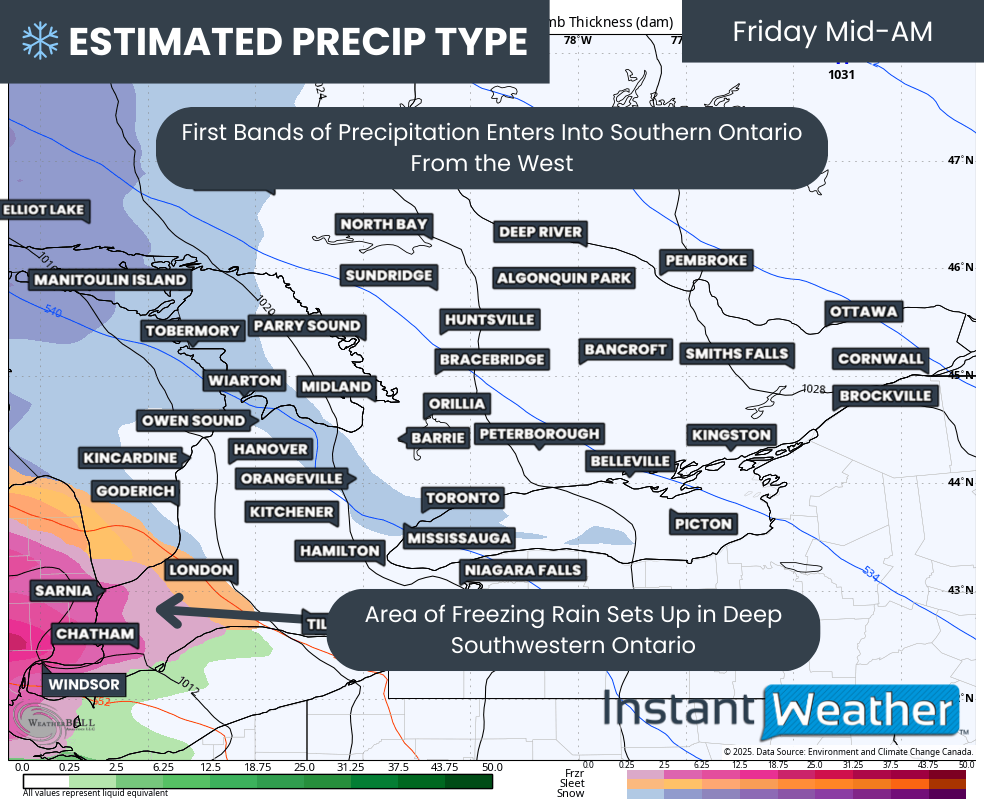
PRECIP TYPE - MAP FROM WEATHERBELL

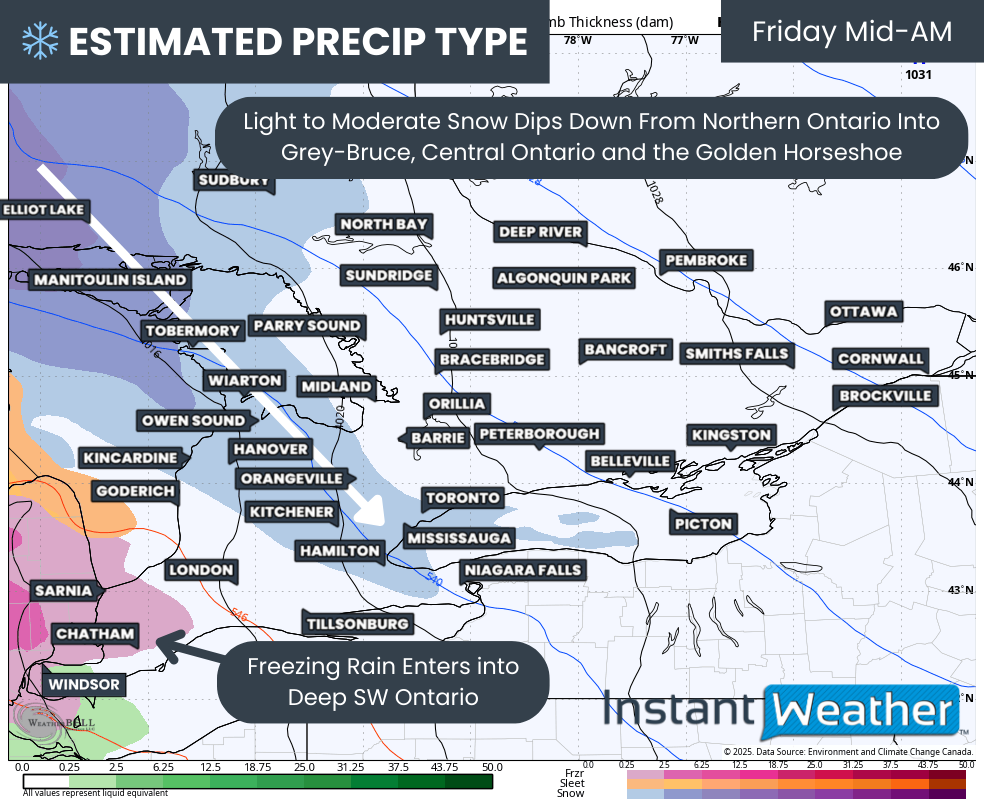
Before we get ahead of ourselves, the immediate focus remains on Friday’s storm. Precipitation is expected to begin during the early to mid-morning hours as bands move in from the west. Light to moderate snow will spread into Grey-Bruce, Simcoe County, Muskoka and the GTA during this time.

For Windsor, Chatham and Sarnia, light freezing rain is expected to begin by mid-morning. Precipitation may be somewhat scattered at first but will steadily increase in coverage and intensity as the morning progresses.

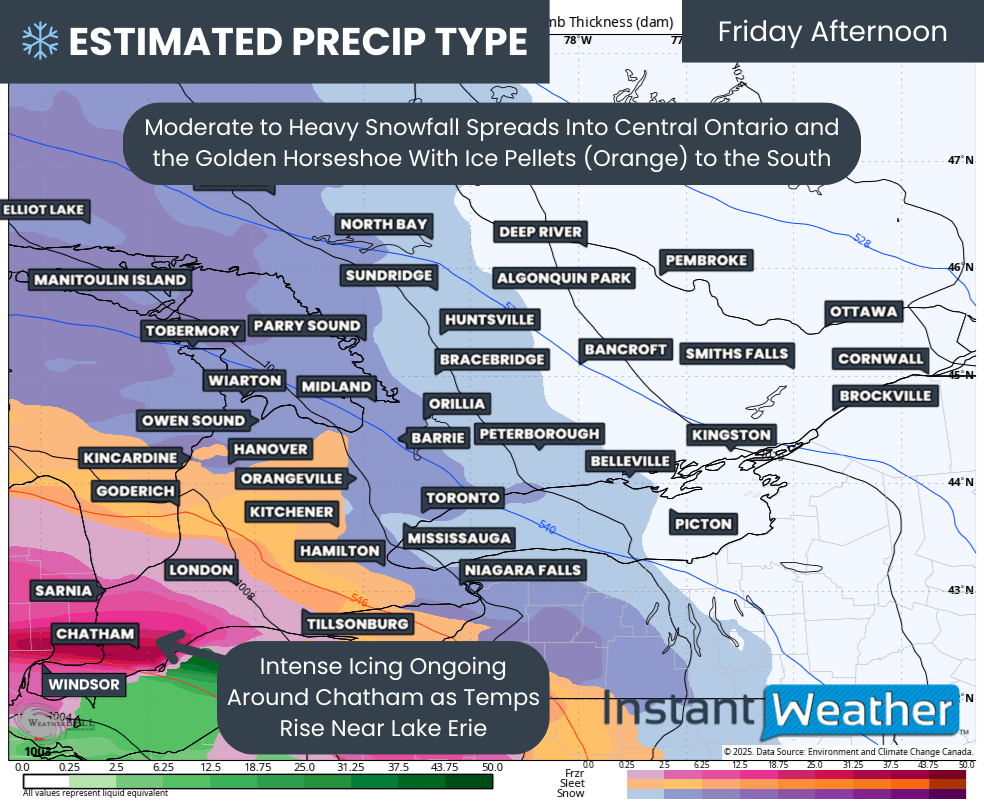
PRECIP TYPE - MAP FROM WEATHERBELL

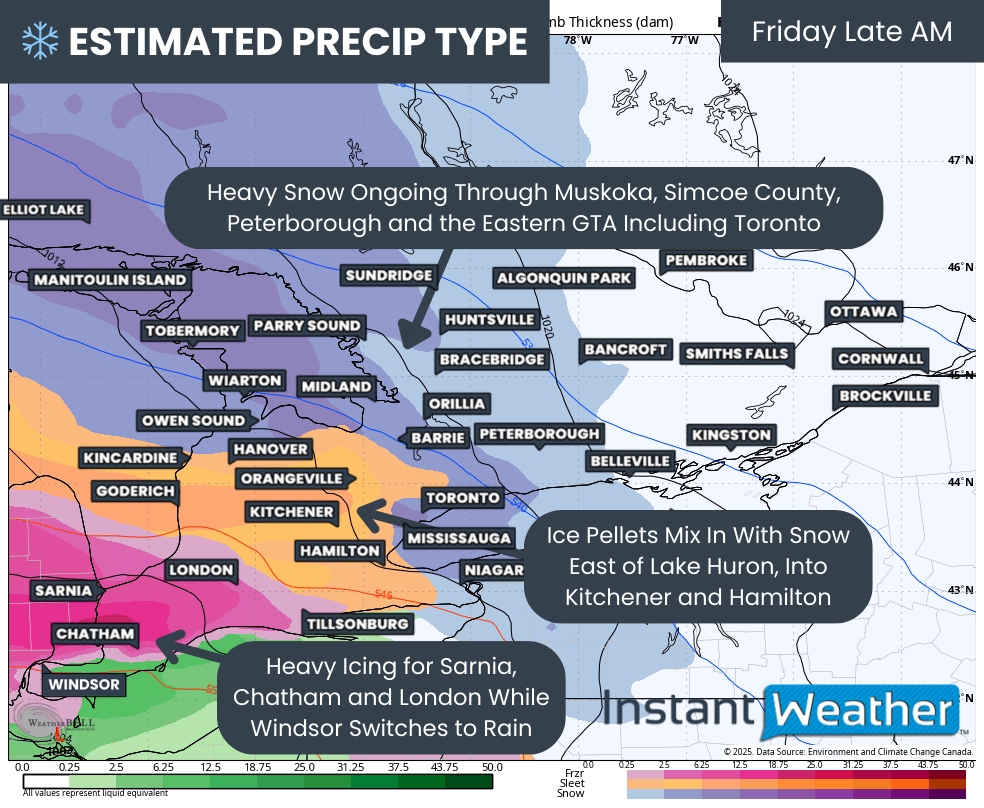
By late morning, the worst conditions should be underway, with heavy icing ongoing around Chatham, Sarnia and London. Travel conditions in these areas are expected to deteriorate quickly.

Further north and east, heavy snow will be the main concern across Muskoka, Simcoe County, Peterborough and the eastern GTA, including the City of Toronto.

Between the freezing rain to the southwest and the heavy snow to the north and east, a corridor of ice pellets is expected to develop from the Lake Huron shoreline through Kitchener and into Hamilton.

PRECIP TYPE - MAP FROM WEATHERBELL

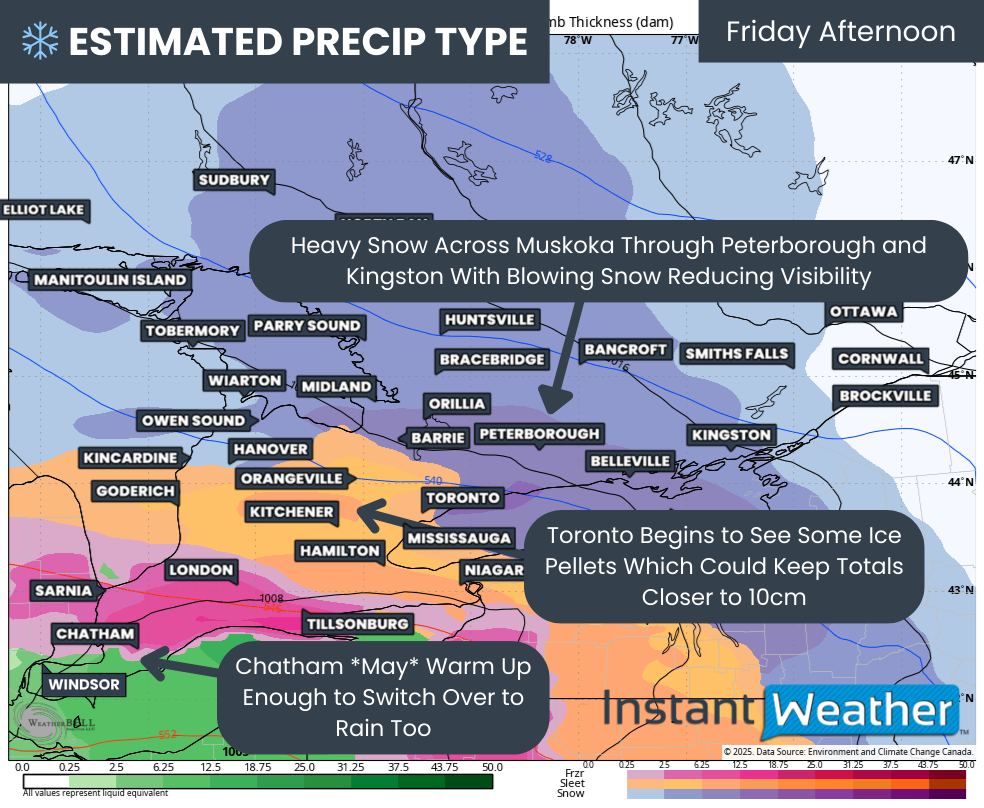
Poor conditions will persist into Friday afternoon, with steady snowfall continuing across Central Ontario into Kingston. Wind gusts approaching 40 km/h may lead to localized blowing snow, further reducing visibility at times.

The ice pellet zone may also push further into the GTA, with Toronto potentially switching over to ice pellets for a time. This would limit snowfall totals and keep them closer to the 10 cm range.

Sarnia and London are expected to remain locked into freezing rain through much of the afternoon. There may be some hope for the Chatham area, where temperatures could briefly rise just above freezing and allow a changeover to rain by mid-afternoon. However, this is right on the line and could still go either way. Windsor and Leamington are expected to remain solidly in the rain zone.

PRECIP TYPE - MAP FROM WEATHERBELL

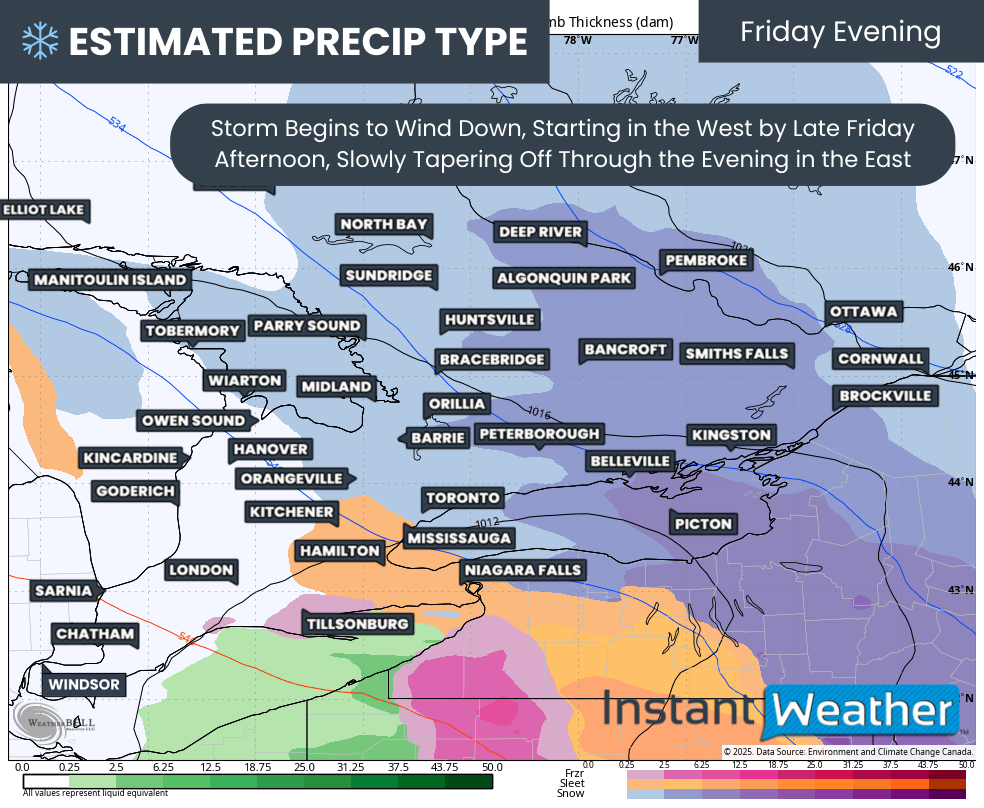
The system is expected to gradually wind down later Friday afternoon and into the early evening. Precipitation will taper off first across western areas, then slowly come to an end across the Golden Horseshoe and Eastern Ontario by late evening.

NOTE: YOU CAN CLICK ON THE MAP TO OPEN A ZOOMABLE IMAGE

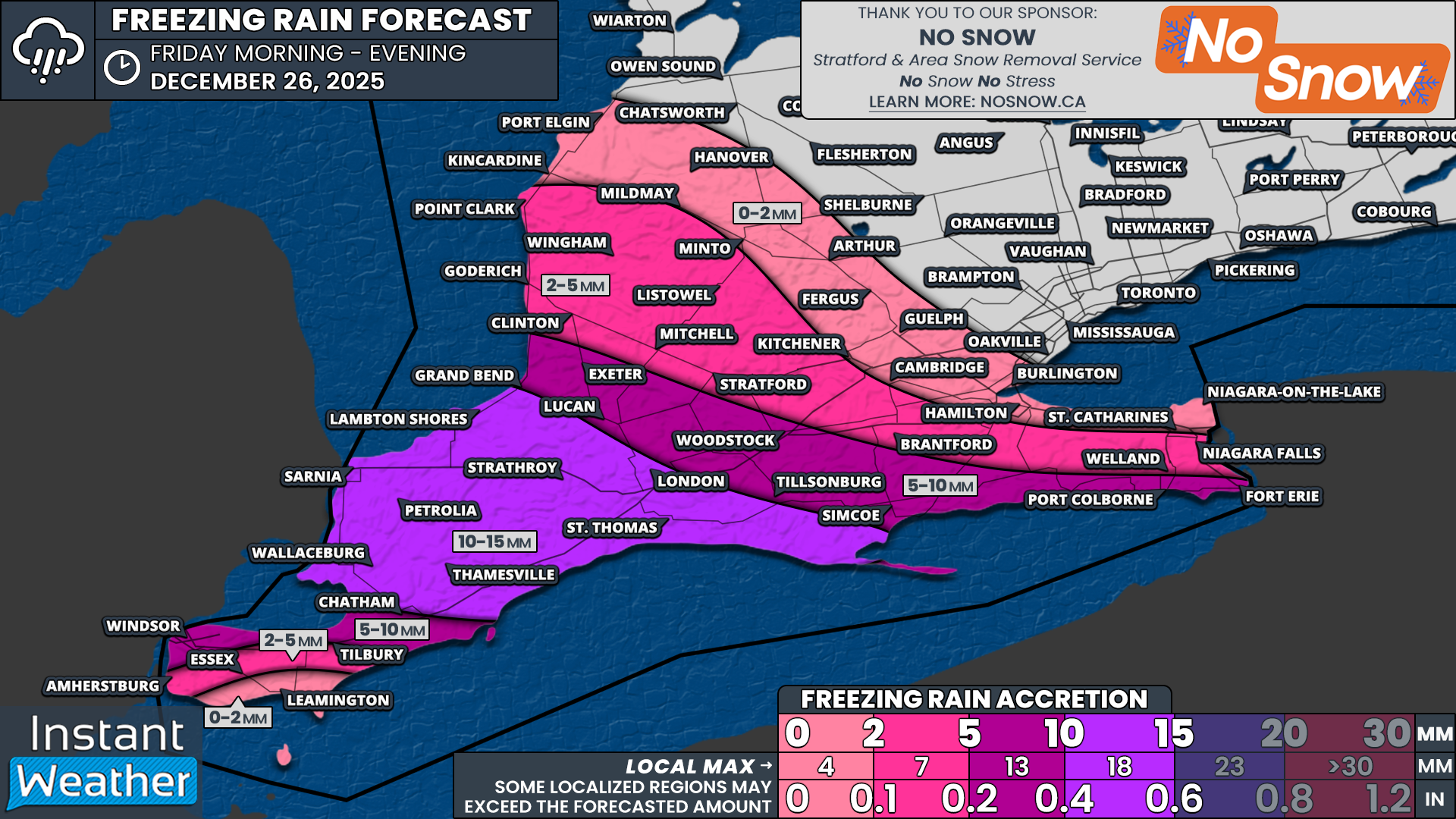
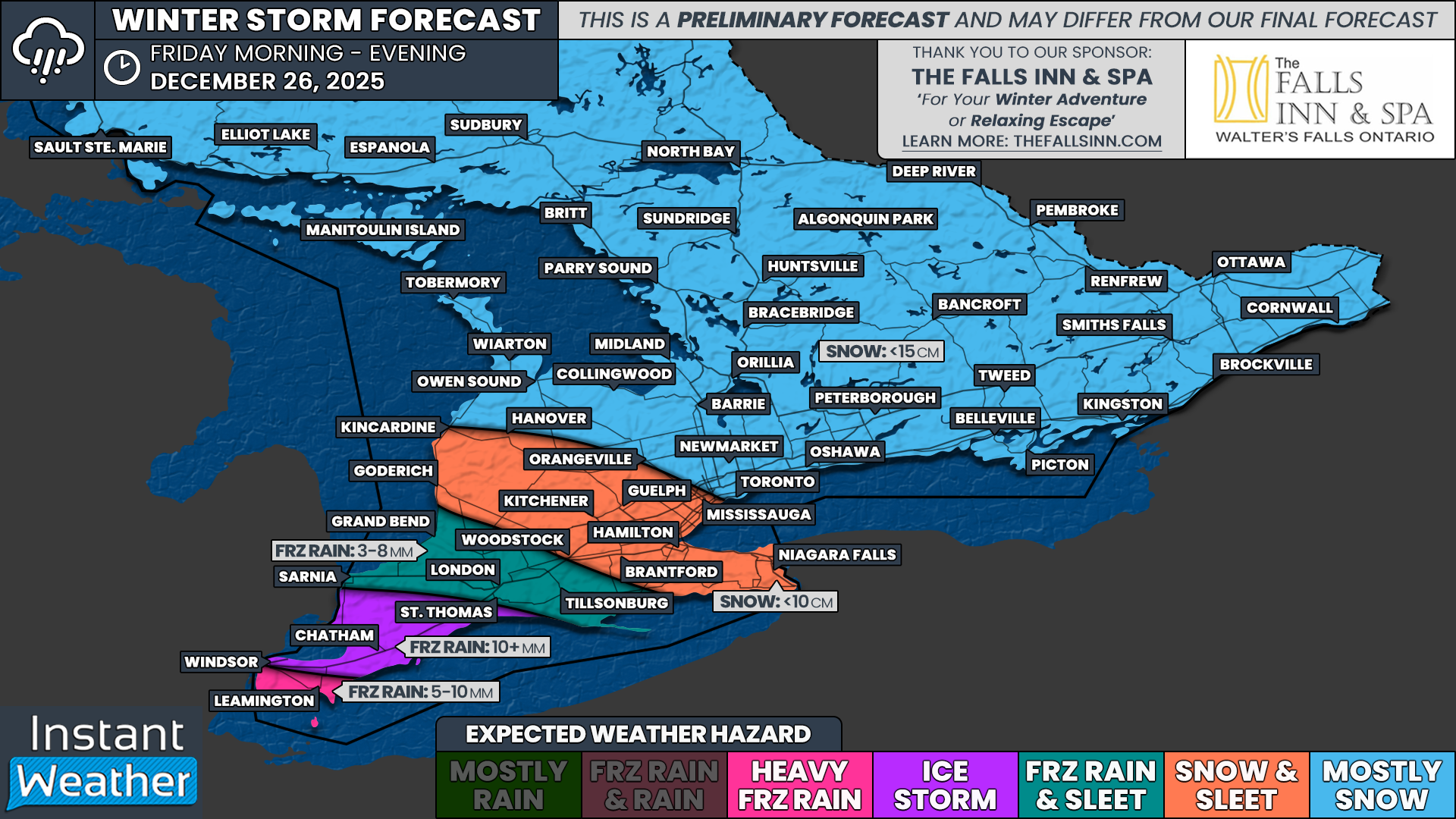
Based on the latest data, the highest ice storm concern has been focused on the Sarnia, Lambton, Middlesex and London corridor. While there is still some disagreement on exact intensity, the potential exists for ice accretion exceeding 10 mm, with localized amounts approaching 15 mm.

Communities included in this higher risk zone include Wallaceburg, Sarnia, Petrolia, Thamesville, Lambton Shores, Grand Bend, St. Thomas and London.

Across Essex County, the highest ice accretion is expected in the northern portions of the county, including Windsor and Tilbury. These areas could see 5 to 10 mm of ice before a changeover to rain. Closer to the Lake Erie shoreline, including Leamington, icing should be minimal, generally under 2 mm, as temperatures rise above freezing more quickly.

Further north, freezing rain amounts will be reduced as ice pellets dominate initially, with freezing rain gradually mixing in later. Locations such as Lucan, Exeter, Woodstock, Tillsonburg, Simcoe, Port Colborne and Fort Erie could see a faster transition to freezing rain, with 5 to 10 mm of ice possible following a few hours of ice pellets.

For Huron and Perth counties, including Kitchener, Brantford and Niagara Falls, ice pellets are expected to linger longer. This will limit freezing rain to only a few hours near the end of the storm, with ice accretion generally in the 2 to 5 mm range. Less than 2 mm of icing is expected for Hamilton, Guelph and southern Grey-Bruce.

NOTE: YOU CAN CLICK ON THE MAP TO OPEN A ZOOMABLE IMAGE

On the snowfall side of the storm, the highest totals are expected to range from 10 to 20 cm across Northeastern Ontario, down into Central Ontario and parts of Eastern Ontario.

This includes areas such as Sudbury, North Bay, Parry Sound, Muskoka, Simcoe County, York Region, Toronto, Durham Region, the Kawarthas, Peterborough and Kingston.

Lower snowfall totals are expected in the Ottawa Valley, where amounts of 2 to 5 cm are forecast for Ottawa and 5 to 10 cm from Bancroft into Brockville. This is due to the core of the system’s moisture remaining further south.

South of the heaviest snow band, totals will decrease as ice pellets mix in later in the storm. Grey-Bruce, Orangeville, Guelph and the western GTA are currently expected to see 5 to 10 cm, though some model solutions suggest even less if mixing becomes more dominant.

Even lower snowfall totals are expected east of Lake Huron into Hamilton and Niagara, where less than 5 cm is forecast as ice pellets and freezing rain become the primary precipitation types.

PRECIP TYPE - MAP FROM WEATHERBELL

Once this system exits Friday night, Saturday should bring a brief period of calmer weather. However, that break will be short-lived, as another potentially high-impact winter storm is expected to approach as early as Sunday, possibly arriving in multiple waves.

The overall setup supports the potential for a prolonged area of freezing rain that could remain locked in place into Monday. This raises concern for a significant ice storm event, potentially similar in nature to last winter’s devastating storm across Central and Eastern Ontario.

Those same regions are once again in the early bullseye. While there is still time for this forecast to change, this is the type of setup where residents should begin thinking ahead and preparing for the possibility of extended power outages if the scenario does not improve.

We will continue to monitor this closely and will have a more detailed update once we get through Friday’s storm.

Potential Boxing Day Winter Storm Targets Southern Ontario With Significant Freezing Rain Risk and Up to 15-20cm of Snow

NOTE: YOU CAN CLICK ON THE MAP TO OPEN A ZOOMABLE IMAGE

While winter weather has mostly taken a breather across Southern Ontario over the past week, things are about to turn active again as we head into the final days of 2025.

That change begins on Boxing Day with a messy winter system expected to slide through Southern Ontario. This system will bring a wide range of hazards, including the threat of significant freezing rain in Deep Southwestern Ontario and more widespread snowfall across much of the rest of the region.

There are still some question marks surrounding this storm, particularly when it comes to how strong it ultimately becomes. Some lower-resolution models show a fairly robust system with plenty of moisture to work with. At the same time, higher resolution guidance that is now coming into range is hinting at some drier pockets, which could cause this system to underperform in spots.

Complicating matters further is the fact that this system has the characteristics of an Alberta Clipper. Clippers are notorious for being difficult to forecast since they often lack a deep source of moisture, and small changes can make a big difference in precipitation type and totals.

What we do know at this point is that impacts will vary significantly across Southern Ontario. The highest risk area continues to be Deep Southwestern Ontario, especially the Windsor, Chatham and Sarnia region, which currently sits in the bullseye for prolonged freezing rain.

In these areas, sustained freezing rain could lead to substantial ice accretion on roads, trees and power lines. This would result in dangerous travel conditions and an increased risk of power outages. With over 10mm of icing possible, there is also concern for widespread tree damage as branches struggle under the weight of the ice.

Further north, from areas east of Lake Huron through the Greater Toronto Area and into Central and Eastern Ontario, the primary precipitation type is expected to be snow. Snow will fall steadily through much of the day on Friday with general accumulations of 5 to 15cm by the end of the day. Locally higher amounts approaching 20cm are possible west of Lake Ontario around the Toronto area due to lake enhancement.

PRECIP TYPE - MAP FROM WEATHERBELL

The first bands of precipitation are expected to arrive early to mid-morning on Friday, spreading across Lake Huron into Southwestern Ontario. As the system moves in, it will encounter a stubborn layer of cold air near the surface across Deep Southwestern Ontario, including Windsor, Leamington, Chatham and Sarnia.

At the same time, warmer air will surge in above the surface, creating a classic setup for freezing rain. This warm layer aloft melts the snow into rain, which then freezes on contact with cold surfaces at the ground.

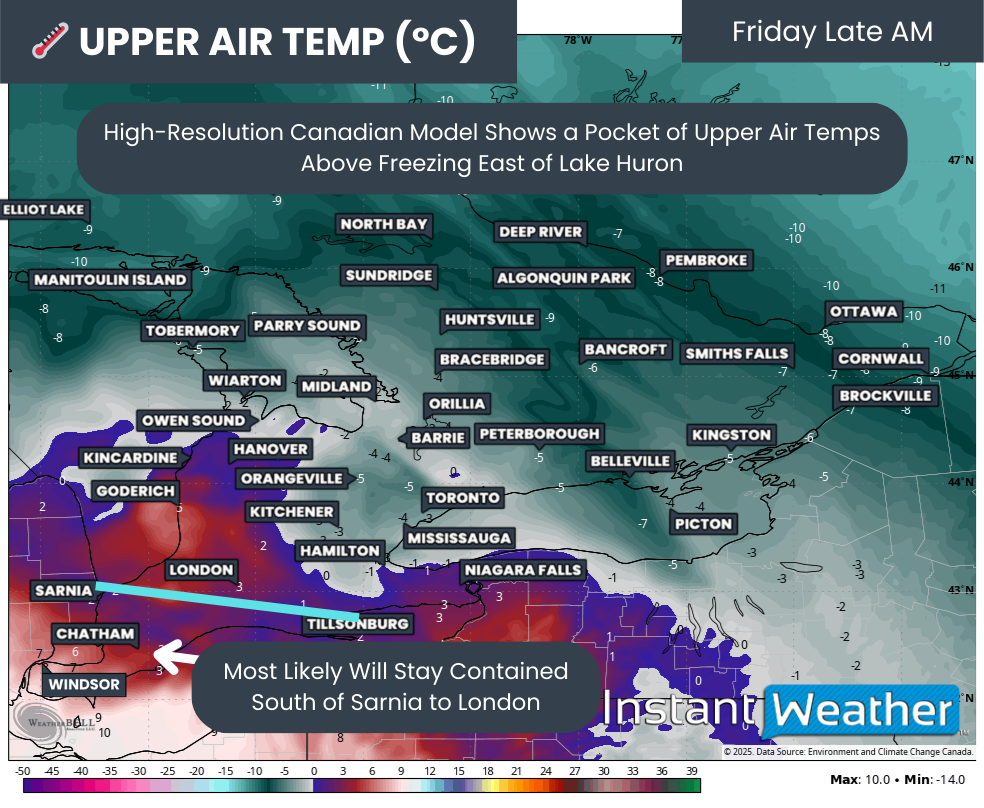
850MB TEMPS (1.5KM ABOVE GROUND) - MAP FROM WEATHERBELL

The biggest challenge with events like this is determining how far north and how deep that warm layer extends. This is the key factor that decides whether precipitation falls as ice pellets or as freezing rain.

Temperatures roughly 1.5km above the surface vary considerably between models. The Canadian model is more aggressive, pushing the warm layer farther north into Southwestern Ontario and even as far as London.

Overall, model consensus places the freezing line somewhere near a Sarnia to London corridor. Areas south of this line are more likely to see freezing rain, while areas to the north will see a mix of ice pellets and snow.

PRECIP TYPE - MAP FROM WEATHERBELL

By the early afternoon, heavier snow will begin spreading into Central Ontario and the Golden Horseshoe as precipitation from Northern Ontario moves southeast across Georgian Bay. At the same time, freezing rain will be ongoing around Windsor, Chatham and Sarnia.

There are indications that temperatures may slowly climb above freezing for southern Essex County, including Leamington and eventually Windsor. There is still disagreement on the exact timing of this changeover, but it appears most likely sometime during the early to mid-afternoon.

If temperatures do rise above freezing, freezing rain would switch to plain rain, and any ice accretion would begin to melt. How quickly this happens will be critical in determining overall impacts. If the warmup is delayed until later in the day or temperatures stubbornly remain below freezing before dropping Friday night again, impacts could be significantly worse.

For areas like Chatham-Kent, Sarnia and St. Thomas, there is growing concern that temperatures may remain below freezing for much of the event. This would allow ice to accumulate for a prolonged period, with over 10mm of accretion possible. Ice amounts of this magnitude are capable of bringing down tree limbs and power lines, potentially leading to power outages that could last for several days.

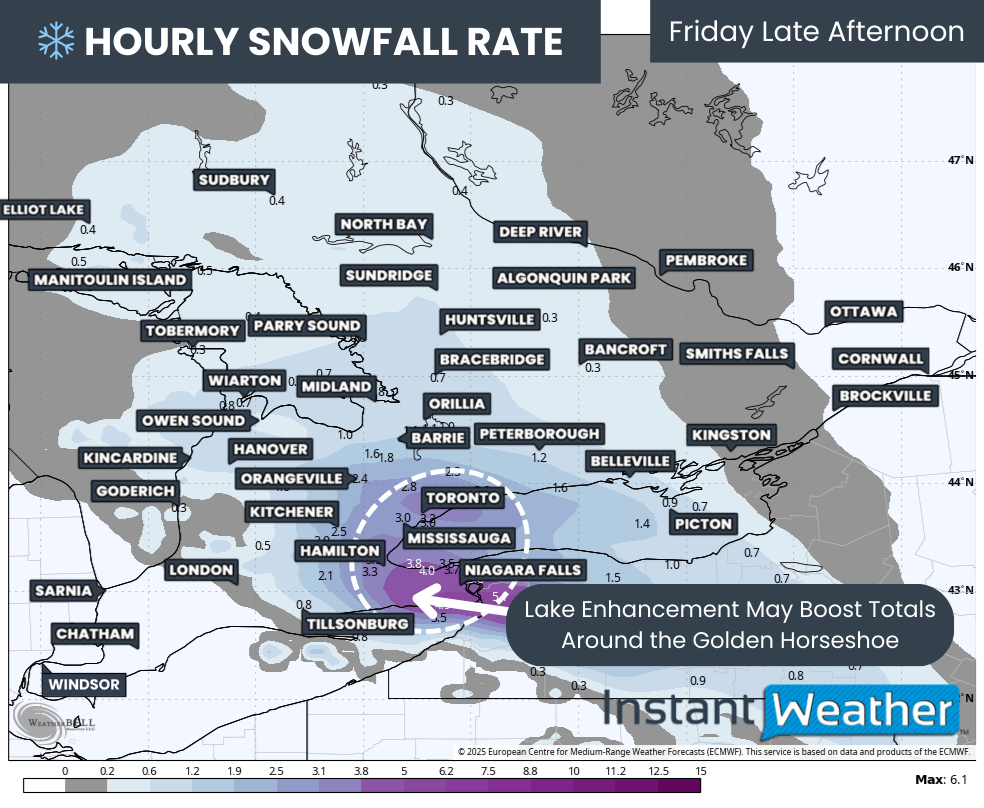
Hourly snowfall rates (cm) - MAP FROM WEATHERBELL

By mid-afternoon, the heaviest snow will be pushing through the Golden Horseshoe. Some models are showing the potential for lake enhancement along the Lake Ontario shoreline from Niagara through Hamilton and into Toronto. If this develops, snowfall rates could briefly spike to 3 to 5cm per hour compared to the more general 1 to 2cm per hour elsewhere.

It is also important to note that ice pellets may mix in at times, which can limit snowfall totals since ice pellets are denser than snow. This is most likely for areas such as London, Kitchener, Hamilton and Niagara, where conditions are more supportive of mixed precipitation. Areas closer to Toronto and farther north into Central Ontario should see more consistent snow.

Light to moderate snow will also spread into Eastern Ontario by the afternoon and continue into the evening before tapering off around midnight. Confidence in snowfall totals here is lower, but amounts in the 5 to 10cm range appear possible by the end of the day.

NOTE: YOU CAN CLICK ON THE MAP TO OPEN A ZOOMABLE IMAGE

While there is decent agreement on the overall track of this system, fluctuations are still very likely. Freezing rain events are among the most difficult to forecast, and even small temperature changes can have major impacts.

At this time, the highest confidence for the worst impacts remains across the Chatham, Windsor and St. Thomas area, where a persistent band of freezing rain is expected to set up for much of the day on Friday. Some models show up to 20mm of liquid precipitation, though not all of that would freeze on surfaces. For now, we are forecasting over 10mm of ice accretion, with the understanding that an overachieving scenario is still on the table.

For southern Essex County, including Leamington and possibly southern Windsor, ice accretion of 5 to 10mm is possible before a changeover to rain. Because of this transition, overall impacts should be lower compared to areas farther north, where freezing rain may last longer.

Farther north, from Sarnia through London and into Norfolk County, precipitation may begin as ice pellets in the morning before transitioning to freezing rain later in the afternoon or early evening. Ice accretion here could range from 3 to 8mm, depending on how quickly this transition occurs.

A corridor stretching from Goderich through Kitchener, Hamilton and into the Niagara region is expected to start with heavier snow Friday afternoon. Mixing with ice pellets later in the day could reduce snowfall totals, with most areas seeing around 5 to 10cm by the end of the event.

Areas that remain predominantly snow from start to finish include Grey-Bruce, much of Central Ontario, Eastern Ontario and the eastern portions of the GTA. Snowfall totals here should generally range from 10 to 15cm, with localized amounts up to 20cm. In Eastern Ontario, especially closer to the Quebec border, totals may struggle to reach 10cm, making 5 to 10cm a more realistic expectation.

We will continue to monitor the latest data closely and will have a more detailed and refined forecast on Thursday night. That update will provide a clearer breakdown of precipitation types and expected amounts. Be sure to check back for the final forecast.

White Christmas Locked In for Parts of Southern Ontario, While Others Face the Risk of a Green Christmas for 2025

NOTE: YOU CAN CLICK ON THE MAP TO OPEN A ZOOMABLE IMAGE

As the big day approaches this Thursday, many across Southern Ontario are starting to ask the big question. Will we wake up to that picture-perfect White Christmas, or will the Grinch sneak in at the last minute and snatch it away from right under our noses (and our carrots)?

In some parts of Southern Ontario, especially the snowbelt regions, it might feel like a White Christmas is already wrapped up and sitting under the tree. These areas were absolutely pummelled by relentless snow squalls earlier this month, leaving behind an impressive snowpack.

But for others, it has been a very different story. Some regions managed to dodge the worst of the snow so far this season, and whatever snow did fall has largely melted away thanks to a recent stretch of milder weather.

That sets the stage for a classic Christmas weather showdown. The Grinch, helped along by a few Heat Miser inspired temperature spikes, will try to erase what little snow remains. Jack Frost, however, is waiting in the wings and is expected to take over closer to Christmas. This makes a weak system expected Tuesday into Wednesday the key player, potentially delivering a last minute chance at a White Christmas for some areas.

CURRENT SNOWFALL DEPTH (cm) - MAP FROM WEATHERBELL

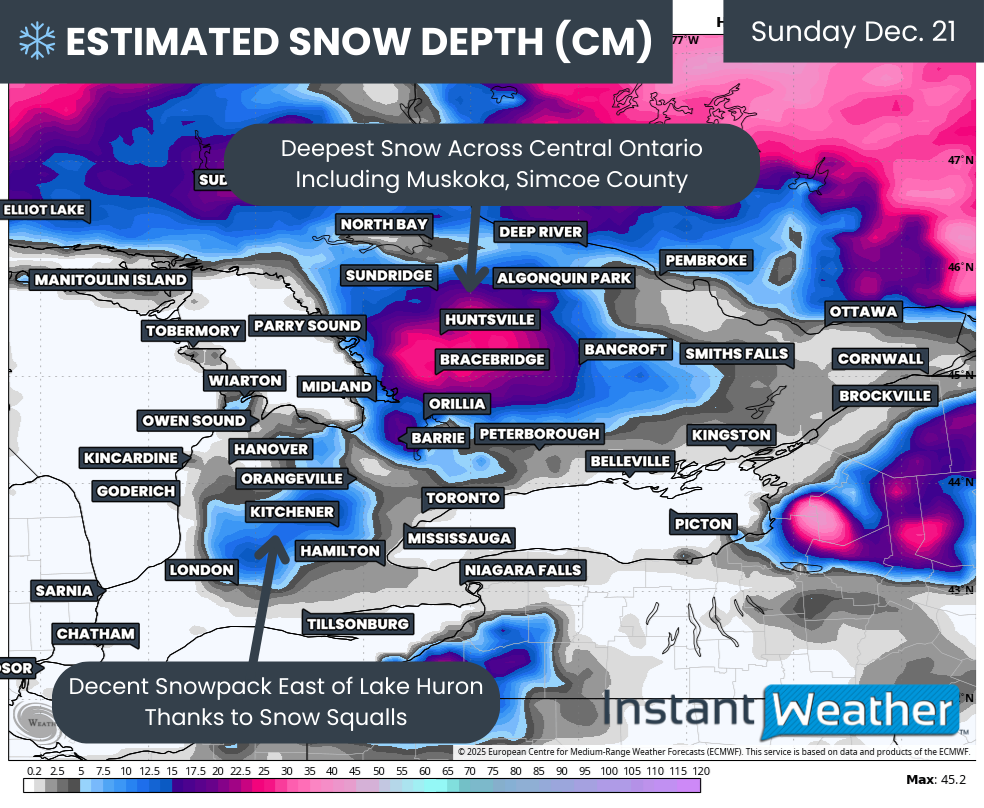
We begin by looking at the existing snowpack, which is often the biggest clue in determining where a White Christmas is all but guaranteed. The most impressive snowpack is found east of Georgian Bay through Simcoe County and into Muskoka, Haliburton and Bancroft.

Model estimates suggest a solid 10 to 25cm of snow on the ground here. These models are fairly low resolution and likely underestimate reality, especially since much of this snow fell during intense lake effect events.

There is also a respectable snowpack of around 5 to 15cm in the higher elevations of Southwestern Ontario, particularly northeast of London. These areas have taken the brunt of snow squall activity several times already this month. Meanwhile, snowpack east of Lake Huron has been noticeably reduced by the recent mild spell.

Outside of those regions, there really is not much snowpack left that can meaningfully contribute to a White Christmas. This includes Deep Southwestern Ontario, the Niagara Region, much of the Golden Horseshoe and into Eastern Ontario, including the Ottawa Valley.

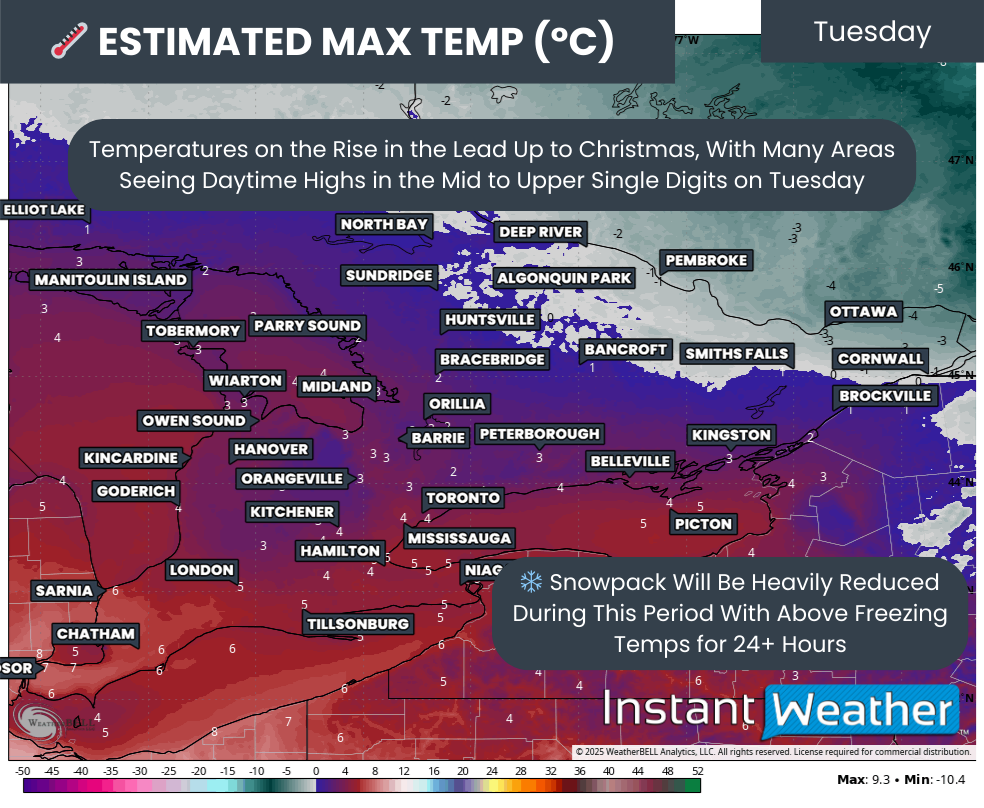
estimated max temp on tuesday - MAP FROM WEATHERBELL

The first challenge arrives early this week as temperatures steadily rise above freezing for more than 24 hours. The warmest day looks to be Tuesday, with daytime highs climbing above freezing across much of Southern Ontario, with the main exception being parts of the Ottawa Valley.

Some areas could even push into the mid to upper single digits, especially in Deep Southwestern Ontario and around the Golden Horseshoe. That is more than enough warmth to put a serious dent in any remaining snow.

Rain may also enter the picture early Tuesday in some areas. Combined with above-freezing temperatures, this will further erode minor snowpack. At that point, the only snow that is truly expected to survive is east of Georgian Bay. For many other areas, including east of Lake Huron, the final outcome will depend heavily on the last 36 hours leading up to Christmas morning.

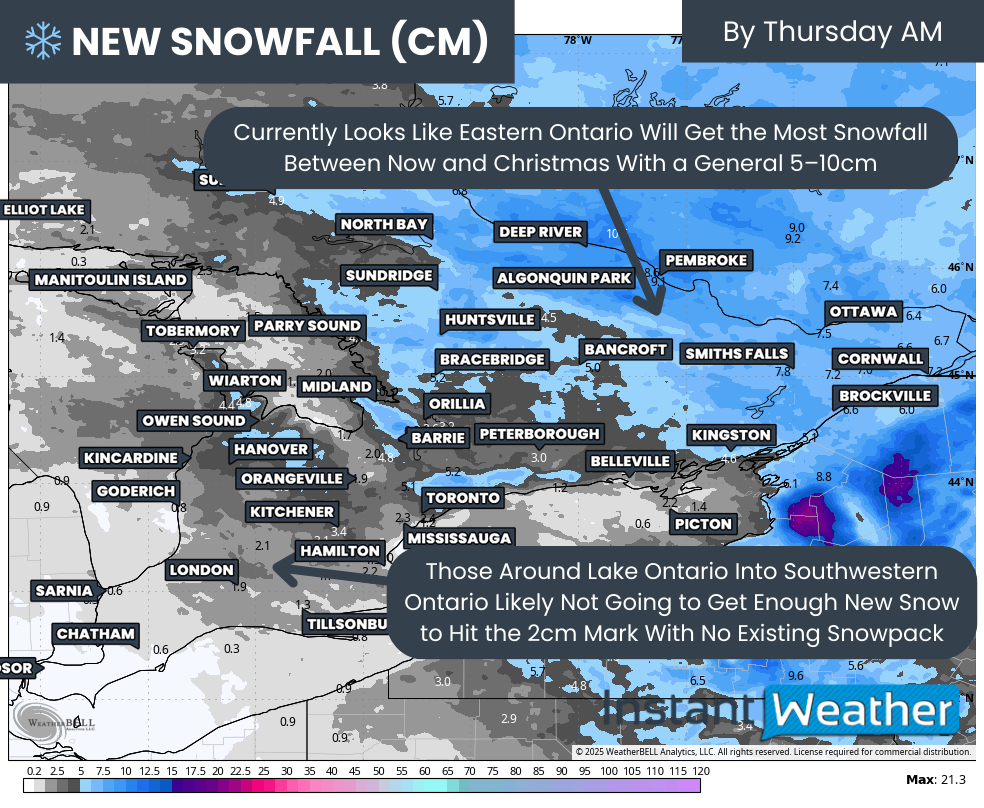
NEW SNOWFALL BY CHRISTMAS MORNING (cm) - MAP FROM WEATHERBELL

The system moving through on Tuesday is expected to bring light snowfall across Eastern Ontario. With temperatures expected to remain below freezing afterward, this snowfall should help lock in a White Christmas for the Ottawa area, even though there is currently very little snow on the ground. A general 5 to 10cm by Wednesday should be more than enough to tip the scales.

In Southwestern Ontario, however, the outlook is not as festive. Much of the snowfall associated with this system is expected to fall before temperatures rise and precipitation transitions to rain. Any snow that does fall will likely melt away quickly.

The one exception may be the higher elevations east of Lake Huron, where temperatures could hover near freezing just long enough for the snowpack to cling on until Christmas morning. Even there, it will be very close.

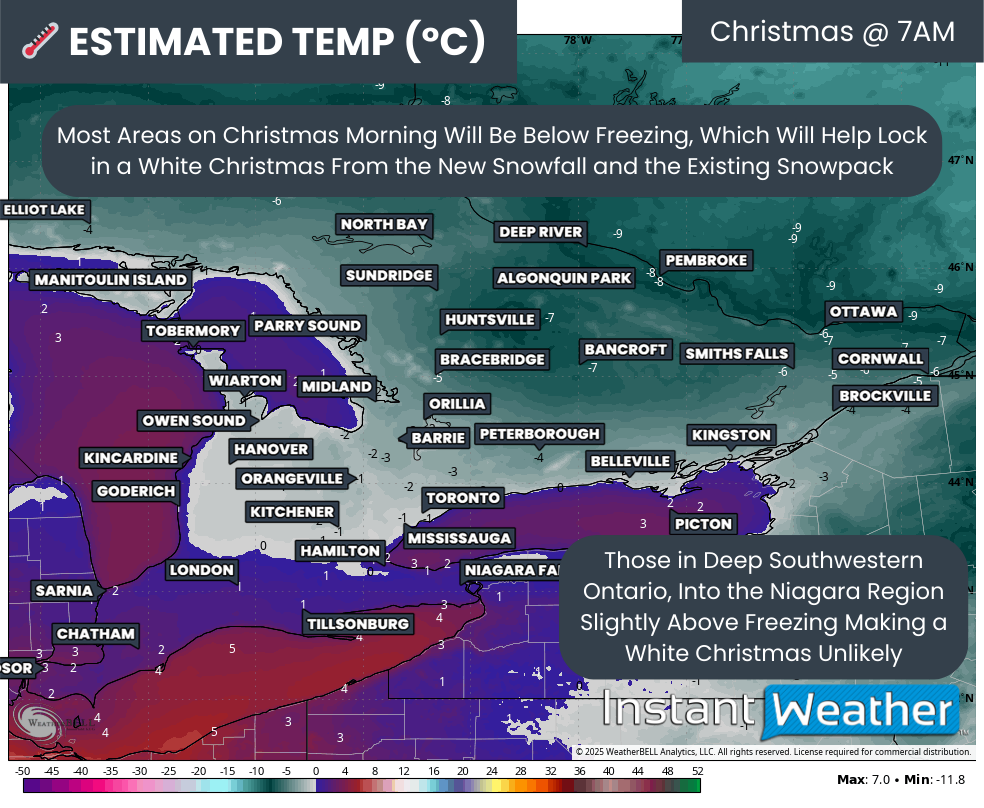
estimated temp on CHRISTMAS MORNING - MAP FROM WEATHERBELL

By Christmas morning itself, current indications suggest many across Southern Ontario will wake up to below freezing temperatures. That will help preserve whatever snow remains on the ground. This includes much of Central and Eastern Ontario, as well as higher elevations northwest of the GTA, such as Orangeville and Kitchener.

In Deep Southwestern Ontario and areas along the Lake Erie shoreline into parts of the GTA, temperatures are expected to be slightly above freezing. With very little existing snowpack to work with, those milder conditions are likely to melt away any lingering hope of a White Christmas.

NOTE: YOU CAN CLICK ON THE MAP TO OPEN A ZOOMABLE IMAGE

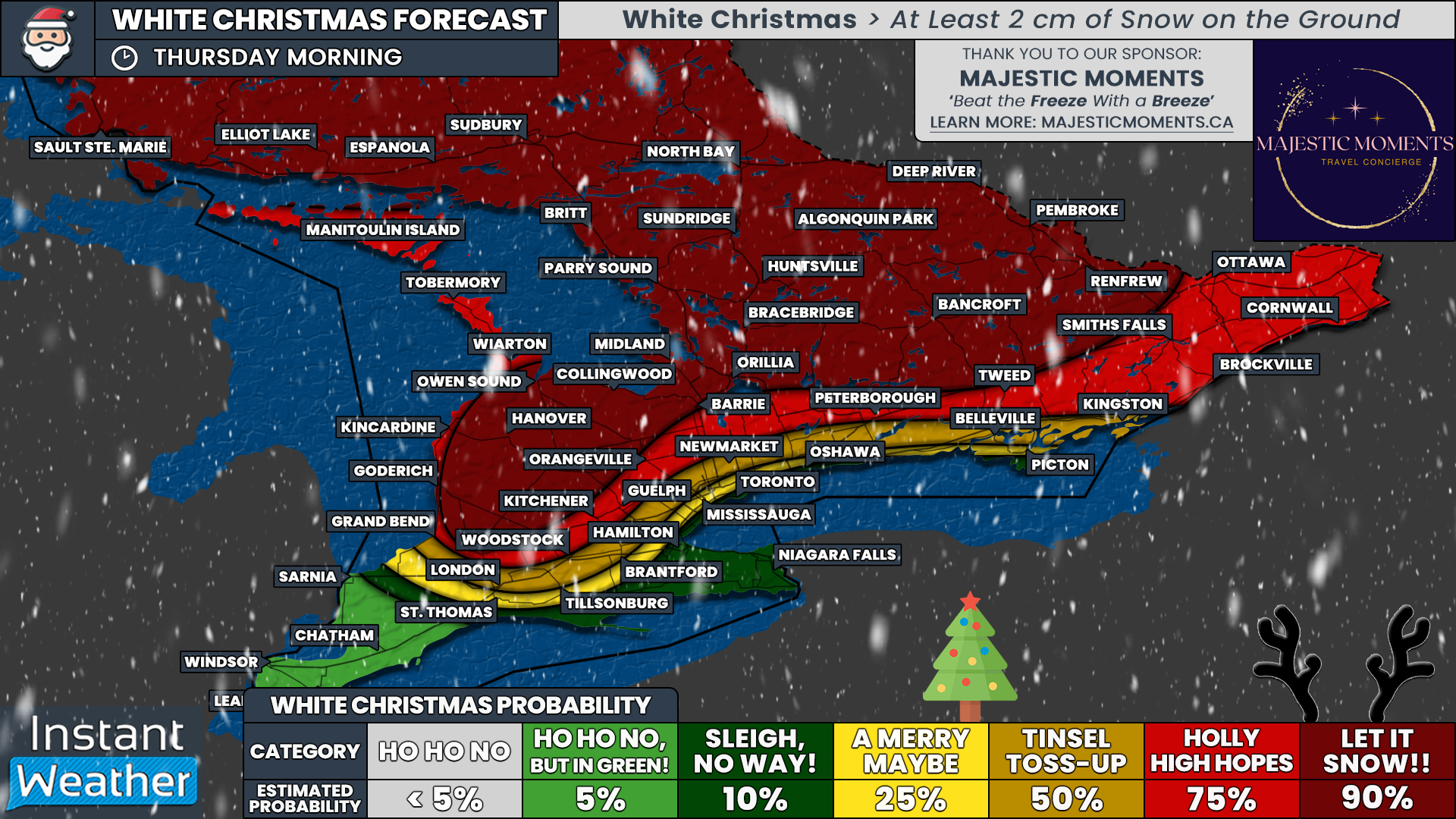
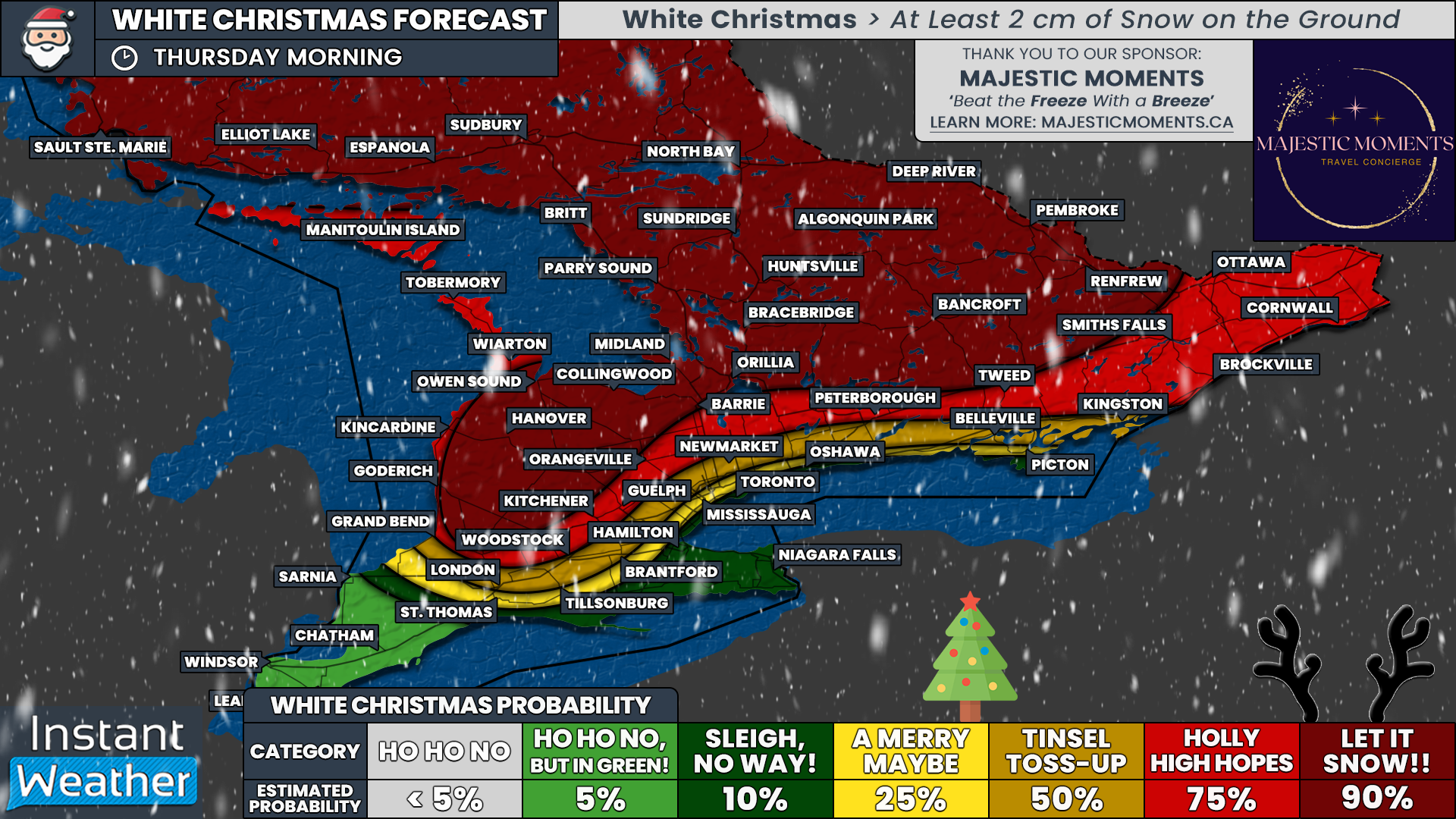
Putting all of this together, we have created our preliminary White Christmas forecast. This is not the final word and adjustments are possible as we get closer to Christmas morning. Several of the uncertainties mentioned above will resolve themselves over the next couple of days, giving us a clearer picture than the models can provide right now.

Our highest confidence area, where we can almost guarantee a White Christmas with a 90 percent chance, covers a wide swath of Central Ontario, including Muskoka, Bancroft and northern and western Simcoe County. These regions have a deep, well-established snowpack. East of Lake Huron, we also assign a 90 percent chance for Hanover and much of Huron and Perth Counties, where repeated lake effect snow has buried the landscape.

Outside of that core region, we currently have a 75 percent chance for much of Eastern Ontario, along with areas such as Peterborough, Barrie and Kitchener. Confidence is fairly strong here, thanks to the existing snow southeast of Georgian Bay and the expected system snowfall in Eastern Ontario on Tuesday.

That said, melting remains a concern for Barrie and Kitchener if temperatures rise a bit more than expected on Tuesday. For Eastern Ontario, confidence also depends on the system delivering as forecast, so we want to see that snow on the ground before bumping probabilities any higher.

Closer to Lake Ontario, the dream of a winter wonderland starts to fade. From Kingston through the north GTA corridor and extending into London, we currently place the odds at around 50 percent. Along the immediate Lake Ontario shoreline, including much of the GTA, things become even more questionable with only about a 25 percent chance of a White Christmas.

For those in the Niagara Region and Deep Southwestern Ontario, including Windsor, Chatham and Sarnia, it may take a true Christmas miracle. Unless a last-minute snowmaker slides through just before Christmas morning, it looks like the Grinch may win this one.

We will continue to monitor the forecast closely and provide updates as Christmas morning draws nearer. Keep checking back, because in the weather, especially at Christmas, surprises are always possible.

Southern Ontario: School Bus Cancellations and Closures for Friday, December 19, 2025

**Please refresh your page every few minutes to receive the latest update**

Cancellation & Closure Map (English Public and Catholic Schools)

Please note: School board boundaries are a rough estimate. Don’t use this map to determine what school board or weather zone you live in as accuracy isn’t guaranteed.

  • Green = No Cancellations

  • Red = Cancellations (Click for More Details)

  • Purple = School Closures (Click for More Details)

List of Cancellations & Closures

English Public and Catholic Schools

  • Avon MaitIand Public & Huron-Perth CathoIic: There are several closures/cancellations, please visit this link for more details: https://hpsts.mybusplanner.ca/Alerts

  • BIuewater Public & Bruce-Grey Catholic: All busses are cancelled.

  • Dufferin-PeeI Catholic: Buses to St. Andrew, St. Peter, St. Benedict as well as ALL buses to Robert F. Hall CSS are cancelled today due to weather and road conditions.

  • Kawartha Pine Ridge Public & Peterborough Victoria Northumberland Clarington Catholic: Bus and transportation service is cancelled to ALL schools in the STSCO jurisdiction for the day.

  • Near North Public & Nipissing-Parry Sound CathoIic: Bussing for all weather corridors are cancelled today.

  • Rainbow Public & Sudbury Catholic: All school related transportation services operating in the districts of SUDBURY, ESPANOLA, MASSEY AND MANITOULIN are cancelled today.

  • Simcoe County Public & Simcoe Catholic: Busses are cancelled for Muskoka.

  • Thames Valley Public & London CathoIic: Busses are cancelled today for Middlesex, Oxford, and Elgin Counties and Red Zone.

  • Trillium Lakelands: All school vehicles to schools in all Zones for Trillium Lakelands District School Board have been cancelled.

  • Upper Grand Public & Wellington CathoIic: All busses in Divisions 2, 3, and 4 are cancelled today.

French Schools

  • Conseil catholique MonAvenir: Busses are cancelled for schools in Peterborough.

  • Conseil scolaire catholique Providence: Busses are cancelled for Oxford, Middlesex, and Bruce-Grey.

  • Conseil scolaire public du Grand Nord de l’Ontario (CSPGNO): All school related transportation services operating in the districts of SUDBURY, ESPANOLA, MASSEY AND MANITOULIN are cancelled today.

  • Le Conseil scolaire public du Nord-Est de l’Ontario (CSPNE) & Conseil scolaire catholique Franco-Nord: Bussing for all weather corridors are cancelled today.

‘Snow Day’ Forecast: Icy Conditions Could Give Some Students an Early Start to Holiday Break Across Southern Ontario on Friday

For an updated list of school bus cancellations & school closures, please visit our live article: https://instantweatherinc.com/article/2025/12/19/bus-cancellations

NOTE: YOU CAN CLICK ON THE MAP TO OPEN A ZOOMABLE IMAGE

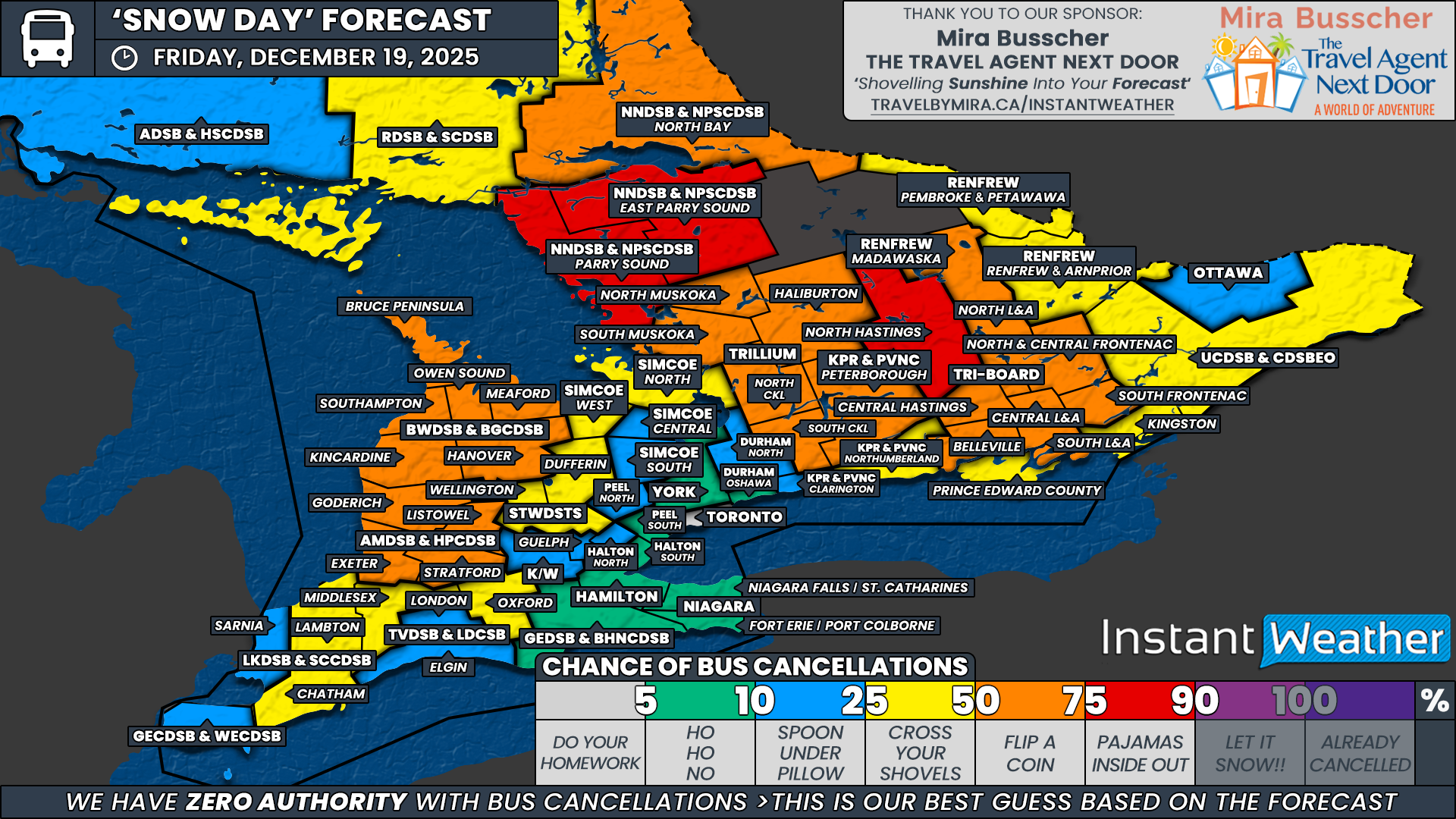
A messy roller coaster of weather is expected across Southern Ontario throughout the day on Friday. It will begin with rain overnight, switching over to heavy snow right around the height of the morning commute. Temperatures will then plunge quickly, leading to the development of icy conditions.

To make things even more complicated, lake effect snow is expected to redevelop east of Lake Huron and Georgian Bay later in the day, with locally 10 to 20 cm of snow possible by Friday evening.

With the rain changing to snow, lining up with the morning commute and temperatures dropping through the freezing mark, there is potential for school bus cancellations, especially in rural areas.

The temperature drop is expected to be fairly gradual, which makes it uncertain whether Environment Canada will issue flash freeze warnings. That uncertainty also makes it harder to determine whether conditions will reach the threshold needed for widespread cancellations.

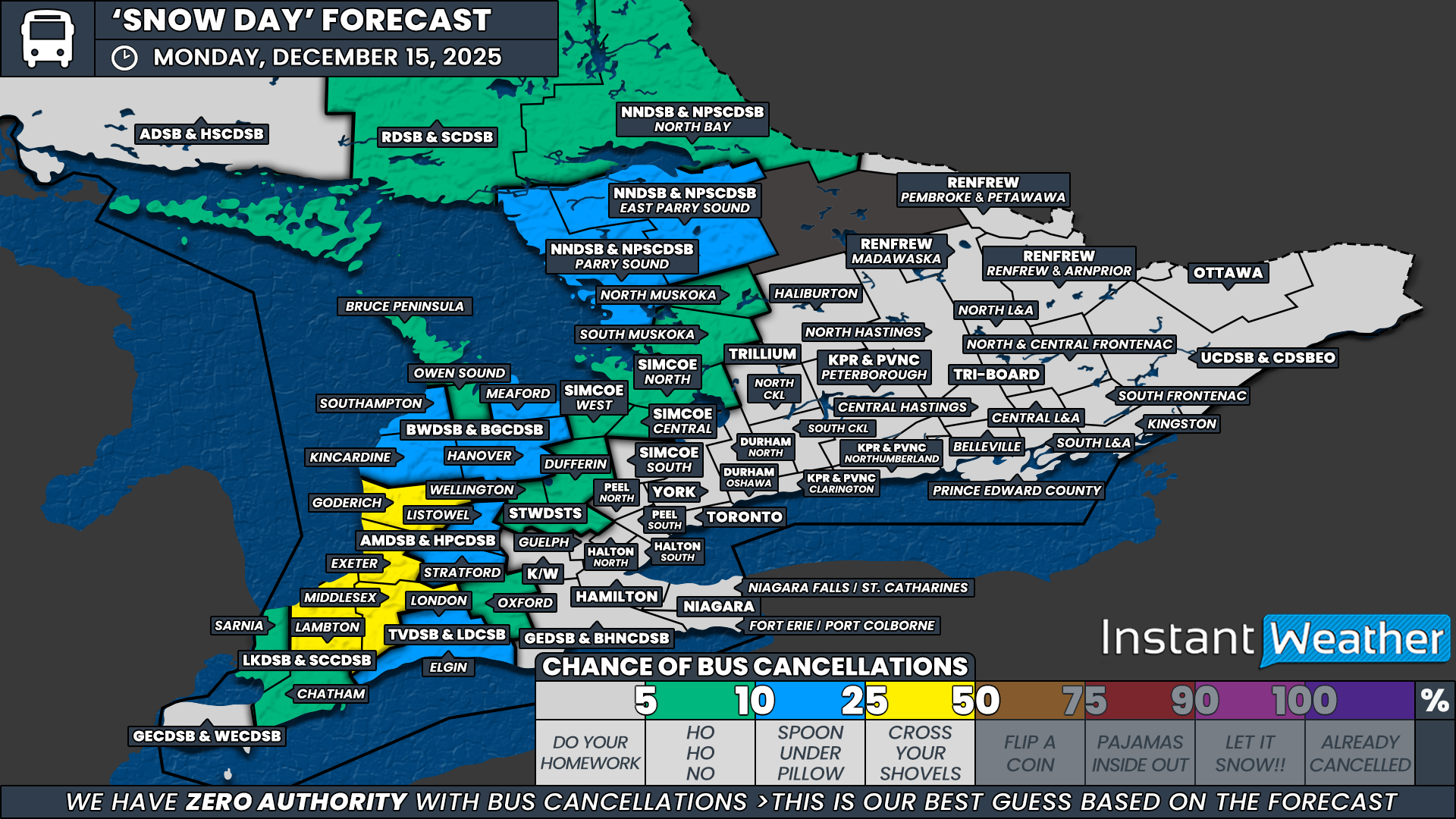
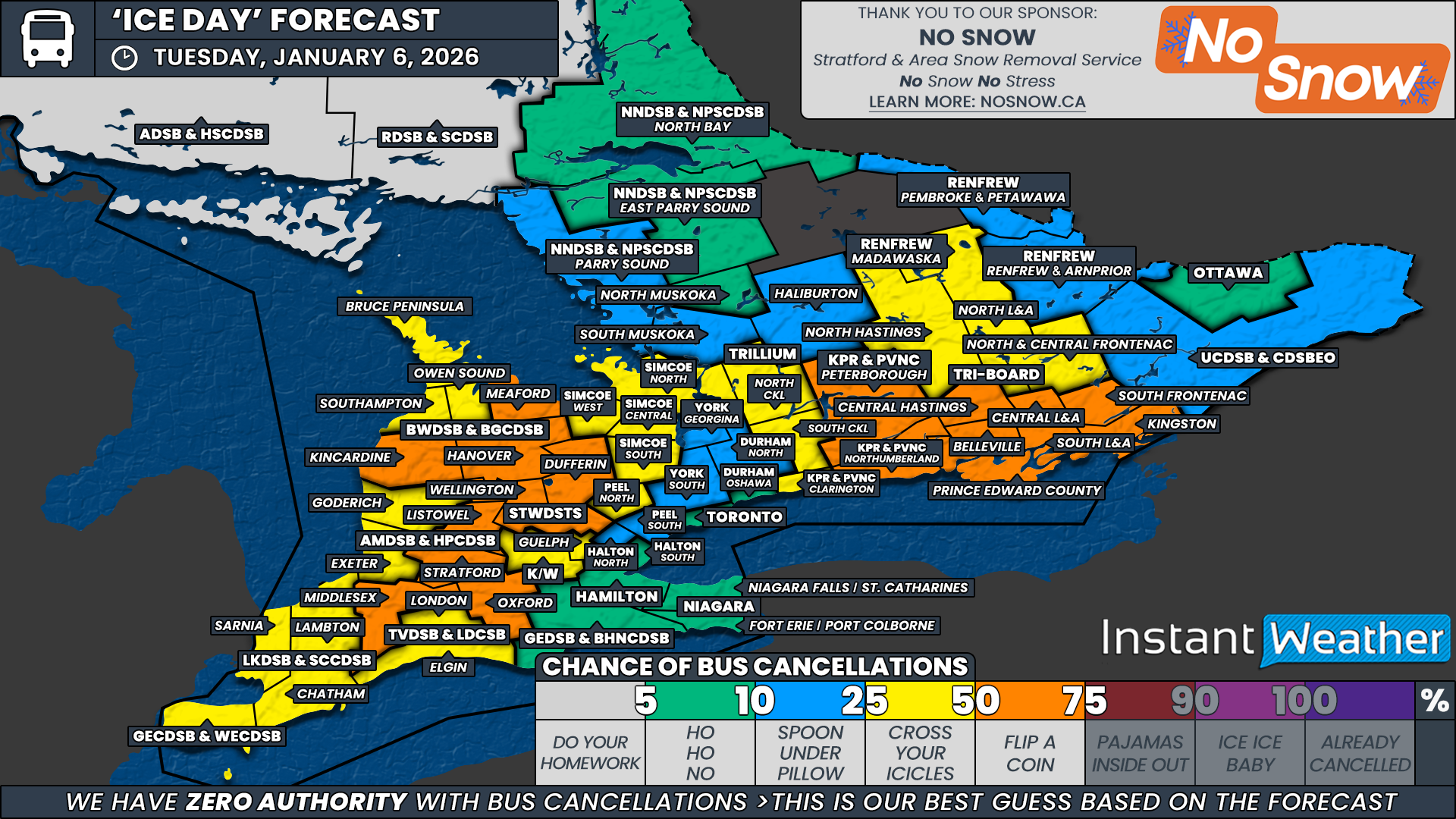
Our highest confidence lies in two regions that tend to be more sensitive to winter weather due to the large number of rural routes they serve. These include the North Hastings zone under Tri-Board Student Transportation Services and the Parry Sound and East Parry Sound regions within the Near North District School Board.

We have assigned these areas a 75 percent chance of bus cancellations. At this point, we are leaning toward cancellations, but not strongly enough to support a higher probability.

Across the broader rural portions of Central, Eastern and Southwestern Ontario, we have assigned a 50 percent chance of school bus cancellations, as conditions could easily go either way. We do expect several cancellations within this widespread zone.

This includes areas covered by the Avon Maitland District School Board, the Trillium Lakelands District School Board, North Bay under the Near North District School Board, Peterborough County within the Kawartha Pine Ridge District School Board, and much of Tri-Board Student Transportation Services. Kingston and Prince Edward County under Tri-Board sit lower at 25 percent. This zone also includes the Madawaska region within the Renfrew County District School Board.

Outside of these areas, there is still a slight chance of cancellations, although we are leaning toward buses running in most cases. As such, we have assigned a 25 percent chance to Lambton and Chatham-Kent within the Lambton Kent District School Board, Middlesex and Oxford counties under the Thames Valley District School Board, Dufferin and Wellington counties within the Upper Grand District School Board, the Simcoe West and Simcoe North weather zones, as well as the remaining portions of the Renfrew County District School Board and the Upper Canada District School Board.

For the rest of Southern Ontario, which is largely covered by more urban school boards, cancellations are unlikely. This includes Windsor under the Greater Essex County District School Board, London and Waterloo under the Thames Valley District School Board and Waterloo Region District School Board, the Greater Toronto Area including Toronto, Peel, York, Durham and Halton, the Simcoe Central and Simcoe South zones, and the Ottawa region.

Conditions in these areas are not expected to meet typical cancellation thresholds. Still, we have assigned a small 5 to 10 percent chance to account for the possibility of a few surprise decisions if icy conditions become more impactful than currently expected.


Disclaimer: Instant Weather has zero authority when it comes to bus and school closures.

It is completely up to the school boards, bus companies, local authorities, and parents to decide what is best for their children. This is our best guess based on our forecast.

Southern Ontario: ‘Snow/Ice Day’ Forecast for Thursday, December 18, 2025

NOTE: YOU CAN CLICK ON THE MAP TO OPEN A ZOOMABLE IMAGE

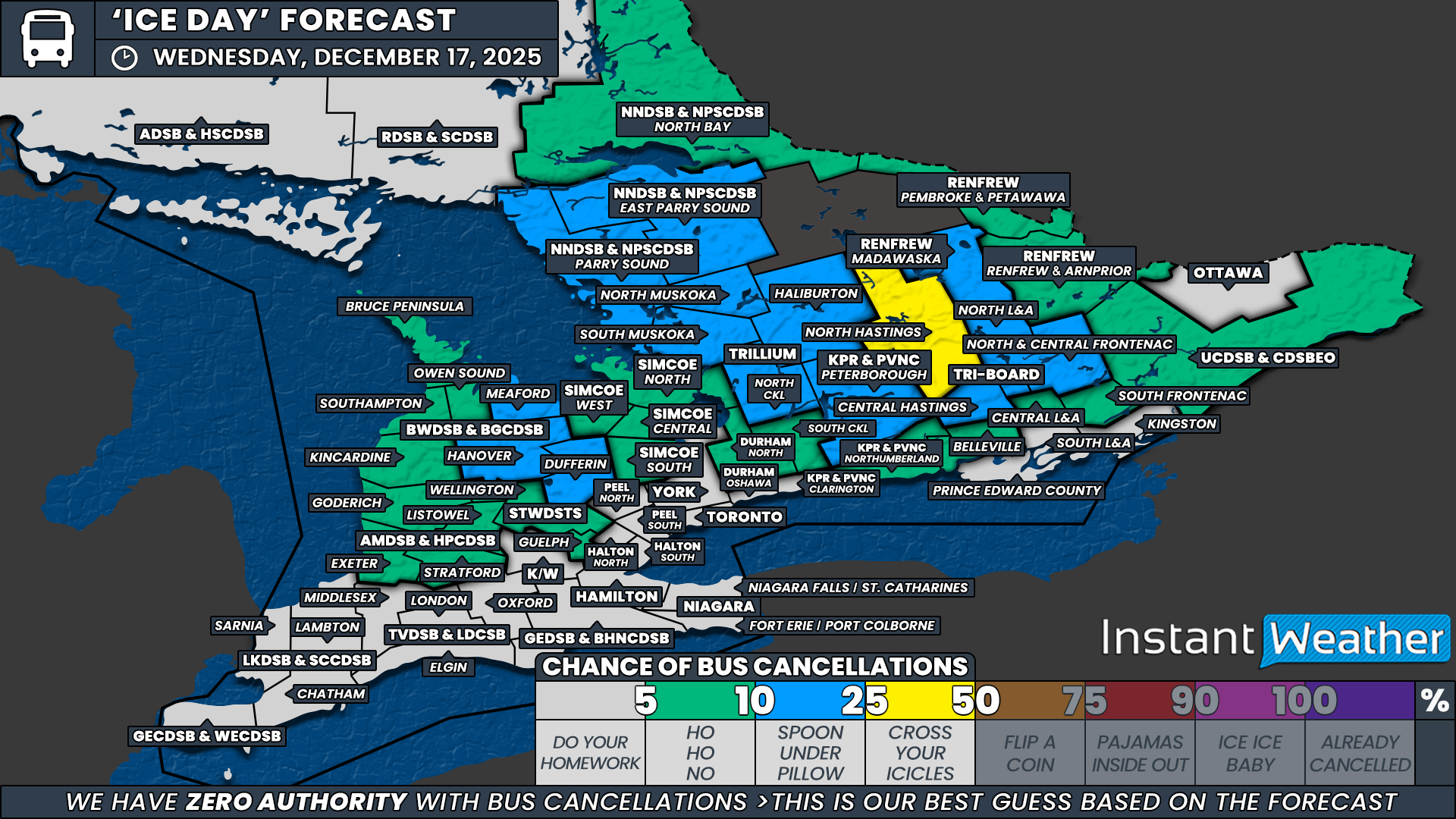
No major winter weather is expected across Southern Ontario on Thursday, and because of this, widespread school bus cancellations are unlikely.

That said, many areas have seen temperatures climb above freezing during the day on Wednesday, followed by an expected drop back below freezing later tonight and into early Thursday morning. This setup could allow for some localized icy conditions to develop, especially on rural roads.

Because of this possibility, we have assigned a widespread low to very low chance for an “ice day” across parts of Central and Eastern Ontario, as well as higher elevation areas of Southwestern Ontario.

We are not expecting cancellations, but if back roads become icy enough in a few localized spots, a surprise decision cannot be completely ruled out.


Disclaimer: Instant Weather has zero authority when it comes to bus and school closures.

It is completely up to the school boards, bus companies, local authorities, and parents to decide what is best for their children. This is our best guess based on our forecast.
Southern Ontario: ‘Snow/Ice Day’ Forecast for Wednesday, December 17, 2025

NOTE: YOU CAN CLICK ON THE MAP TO OPEN A ZOOMABLE IMAGE

Patchy freezing drizzle or light freezing rain is expected to develop across portions of Southwestern, Central and Eastern Ontario overnight Tuesday and into Wednesday morning.

While this freezing rain risk is not expected to be particularly impactful or widespread, it could still lead to a thin glaze of ice forming on untreated surfaces. This includes rural roads, sidewalks and vehicles, especially in areas where temperatures hover near the freezing mark through the night.

At this time, conditions are not expected to reach the threshold that would normally prompt widespread school bus cancellations. However, we cannot completely rule it out, especially if Environment Canada issues advisories overnight or if the freezing rain ends up being more widespread than currently forecast.

The most likely region to see an “ice day” is the North Hastings zone within Tri-Board Student Transportation Services. This area has a long history of being particularly cautious, largely due to its extensive network of rural routes where back road conditions can deteriorate quickly, even during relatively minor icing events. We have assigned this region a 25 percent chance to reflect that slightly elevated risk, though the overall lean remains toward buses running without major issues.

Elsewhere across the rural portions of Eastern, Central and Southwestern Ontario, we have assigned a low 5 to 10 percent chance of cancellations. Most school boards are expected to operate normally on Wednesday, but a few localized decisions cannot be ruled out depending on overnight road conditions.

This includes areas covered by Tri-Board, the Renfrew County District School Board, the Upper Canada District School Board, the Kawartha Pine Ridge District School Board, the Trillium Lakelands District School Board, the Near North District School Board, the Simcoe County District School Board, the northern portion of the Durham District School Board, the Upper Grand District School Board, the Bluewater District School Board and the Avon Maitland District School Board.

Outside of these regions, no weather-related school bus cancellations are expected on Wednesday. So for now, it looks like homework remains on the schedule.


Disclaimer: Instant Weather has zero authority when it comes to bus and school closures.

It is completely up to the school boards, bus companies, local authorities, and parents to decide what is best for their children. This is our best guess based on our forecast.
ONTARIO: Environment Canada Forecasting Snow, Flash Freezing, Heavy Rain, Strong Winds and Extreme Cold This Week

A very active stretch of weather is expected across Ontario this week, with strong winds, snow, blowing snow, ice, heavy rain, and extreme cold all making appearances. Below is a day-by-day breakdown summary based on the latest Environment Canada forecast.

Tuesday, December 16:

- Strong southwest winds gusting up to 70 km/h for areas northeast of Lake Superior, Lake Huron and Georgian Bay, including parts of Manitoulin Island.

- Risk of flash freeze in northwestern Ontario as temperatures drop quickly, creating hidden ice on roads and walkways.

- Winds ease by late Tuesday night into early Wednesday.

NOTE: TAP OR CLICK THE IMAGE TO OPEN A VERSION YOU CAN ZOOM

Wednesday, December 17:

- Significant wind chills near -40°C in far northwestern Ontario.

- Strong winds along the northeastern shores of Lake Erie and Lake Ontario, with gusts up to 80 km/h.

- Brief burst of snow and blowing snow across northeastern Ontario as a cold front sweeps through.

- Snow spreads into northwestern Ontario later in the day and continues overnight.

NOTE: TAP OR CLICK THE IMAGE TO OPEN A VERSION YOU CAN ZOOM

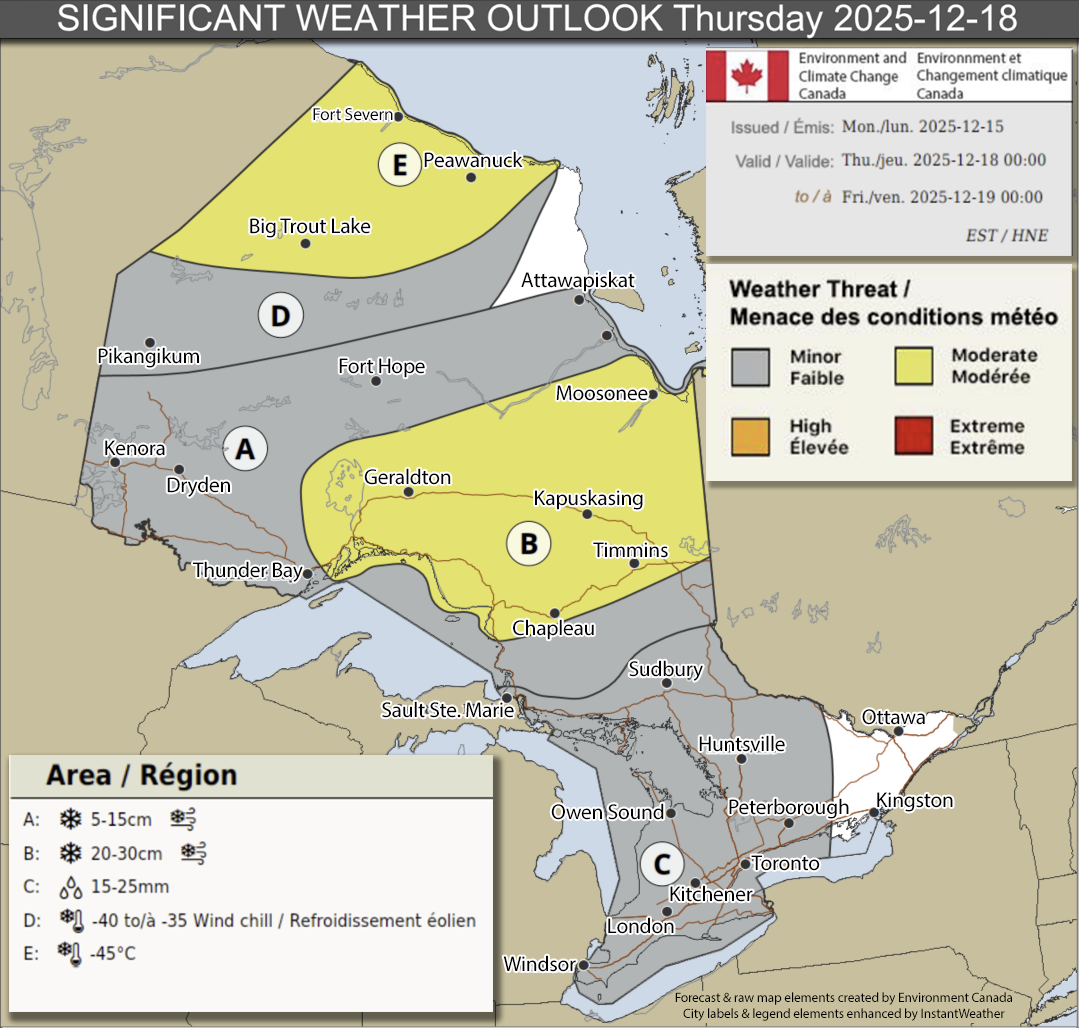
Thursday, December 18:

- Strengthening low-pressure system brings 20–30 cm of heavy snow north of Lake Superior toward the Quebec border.

- Additional 5–15 cm of snow across northern Ontario.

- 15–25 mm of rain in southern Ontario on frozen ground, increasing localized flooding risk.

- Rain transitions to snow Thursday evening as temperatures fall.

- Extreme wind chills near -45°C in far northwestern Ontario.

NOTE: TAP OR CLICK THE IMAGE TO OPEN A VERSION YOU CAN ZOOM

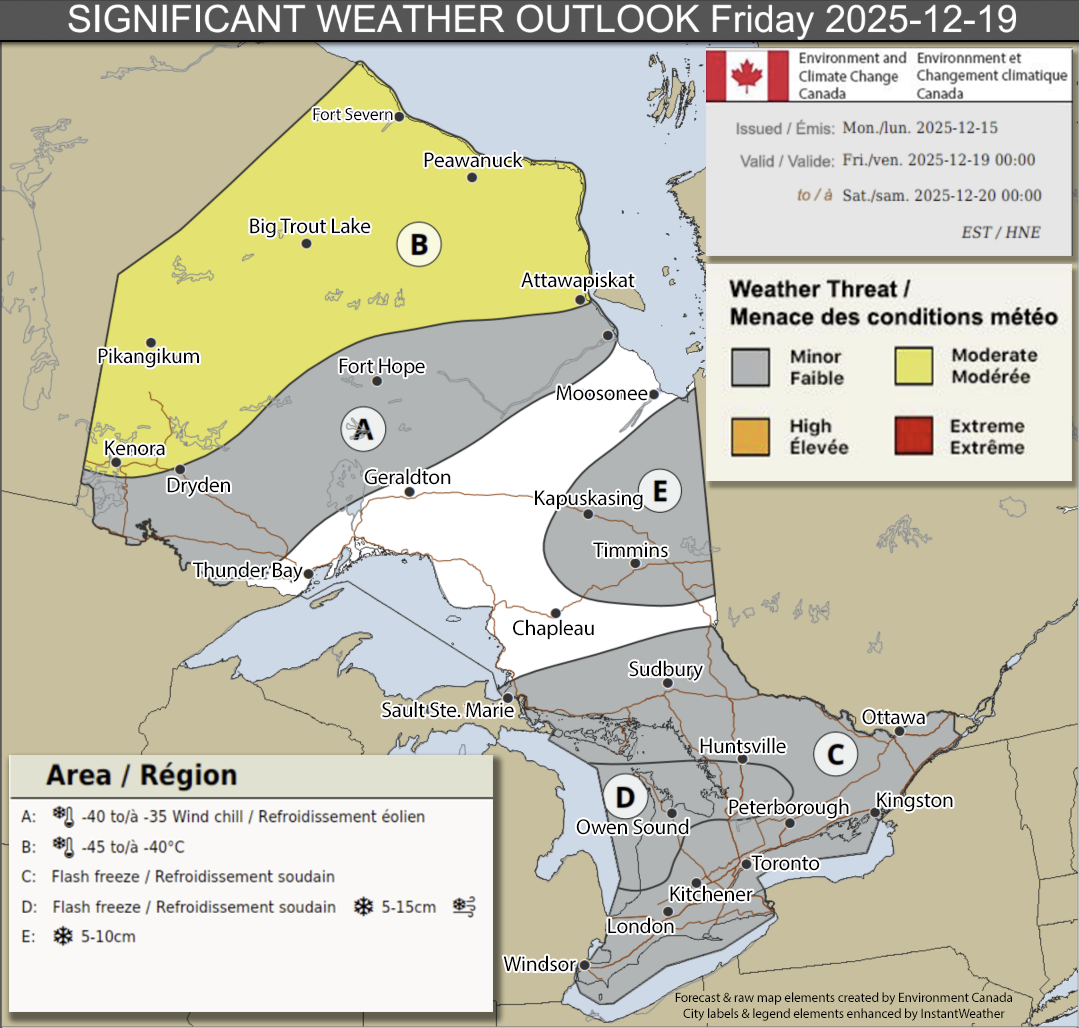
Friday, December 19:

- A flash freeze risk across southern Ontario during the morning commute as temperatures plunge.

- Snow squalls east of Lake Huron and Georgian Bay may deliver 5‑15 cm of snow and create near-zero visibility at times.

- Additional 5‑10 cm of snow possible across northeastern Ontario.

- Extreme wind chills of -40 to -45°C persist across northwestern and far northern Ontario.

- Continued risk of frostbite and hypothermia due to the bitter cold in the northwest.

NOTE: TAP OR CLICK THE IMAGE TO OPEN A VERSION YOU CAN ZOOM

Long story slightly longer, a prolonged stretch of active weather is expected with high winds, snow, flash freezing, rain and extreme cold affecting different parts of Ontario. Stay safe and warm, everyone and make sure to download our free app InstantWeather to get the most up-to-date, detailed forecast for your specific location.

Southern Ontario: ‘Snow Day’ Forecast for Tuesday, December 16, 2025

NOTE: YOU CAN CLICK ON THE MAP TO OPEN A ZOOMABLE IMAGE

We are expecting a fairly quiet day weather-wise on Tuesday across Southern Ontario, with no major weather in place to cause widespread travel issues.

Because of this, there is nothing in the forecast that would suggest a strong likelihood of school bus cancellations.

The only area with any notable chance is the Parry Sound region under the Near North District School Board, where a snow squall warning remains in effect. That activity is expected to weaken overnight, making it questionable whether it will have any meaningful impact on the morning commute.

Even so, given this school board’s history of being particularly sensitive to weather conditions, we cannot completely rule out a surprise decision. As a result, we have assigned Parry Sound a 10 percent chance.

Outside of the Parry Sound area, no weather-related school bus cancellations are expected on Tuesday.


Disclaimer: Instant Weather has zero authority when it comes to bus and school closures.

It is completely up to the school boards, bus companies, local authorities, and parents to decide what is best for their children. This is our best guess based on our forecast.
Southern Ontario: ‘Snow Day’ Forecast for Monday, December 15, 2025

NOTE: YOU CAN CLICK ON THE MAP TO OPEN A ZOOMABLE IMAGE

After an active weekend that featured periods of snow squall activity across portions of Southern Ontario’s snowbelt, conditions are expected to steadily improve later Sunday evening as the lake effect weakens and winds begin to ease.

Because of this, there are no major weather concerns expected overnight that would normally keep school buses off the roads on Monday. Most regions should see calmer conditions by the time the morning bus run begins.

That said, we cannot completely rule out a few isolated cancellations tied to lingering blowing snow and rural roads that may remain snow covered following Sunday’s squalls. Any issues would be highly localized and mainly confined to areas that saw the most persistent snowfall.

If cancellations do occur, they would most likely be found in Huron County under the Avon Maitland District School Board, Middlesex County within the Thames Valley District School Board, and Lambton County for the Lambton Kent District School Board.

We have assigned these regions a 25 percent chance of a snow day on Monday to account for the potential for rural route issues. Widespread cancellations are not expected.

Elsewhere across the snowbelt, we have maintained a low to very low chance simply to account for the outside possibility of a surprise decision.

If a surprise cancellation does occur outside of the regions mentioned above, the most likely candidate would be the Near North District School Board. Some light snow and lake effect activity may redevelop there later in the day, and this board has a history of being proactive when Environment Canada issues alerts. If any alerts are in place by early Monday morning, some cancellations are possible.

For the rest of Southern Ontario, no school bus cancellations are expected on Monday. So for now, it looks like homework is back on the menu.


Disclaimer: Instant Weather has zero authority when it comes to bus and school closures.

It is completely up to the school boards, bus companies, local authorities, and parents to decide what is best for their children. This is our best guess based on our forecast.

Southern Ontario’s Never-Ending Winter Continues This Weekend as Squalls Threaten to Bring Up to 50cm of More Snow

NOTE: YOU CAN CLICK ON THE MAP TO OPEN A ZOOMABLE IMAGE

With a steady parade of system after system, along with lake effect snow in between, it’s certainly understandable that some parts of Southern Ontario are getting pretty fed up with all the snow. The snow continues to pile up, especially across the snowbelt regions!

It was only a few days ago that the Barrie area was slammed with intense lake effect snow, with up to 70cm reported in the hardest hit community of Angus. And that doesn’t even include what was already on the ground before this round of squalls moved through.

Regions east of Lake Huron, including Grey, Bruce, Huron and Perth counties, have also seen their fair share of snow so far this winter, with frequent lake effect events adding to an already deep snowpack.

Fortunately for snow lovers, and perhaps unfortunately for everyone else, the squalls are far from finished. The lakes remain wide open, and we are just getting into the heart of colder Arctic air. That combination will continue to provide plenty of fuel for additional rounds of lake effect snow in the coming weeks.

The next round of squalls is just around the corner, with activity expected to ramp up again as early as Saturday morning. The good news for areas that were recently hammered by the Georgian Bay squall, including Barrie and Wasaga Beach, is that you should catch a bit of a break this weekend. The bulk of the activity will focus farther north and west.

Those east of Lake Huron, including Huron, Bruce and Grey counties, are not as lucky. Lake effect snow off Lake Huron is expected to target these areas once again with repeated rounds of snow through the weekend.

This is shaping up to be a multi-day lake effect event, with squalls persisting through the weekend and possibly into Monday. Winds are expected to be somewhat unstable, which means the squalls will tend to drift around rather than remain locked over one specific area. Because of this, it’s unlikely we’ll see extreme localized totals like the 50 to 75cm that fell southwest of Barrie earlier this week.

That said, snowfall totals will still add up. The hardest hit areas, including Parry Sound, Bracebridge, Tobermory, Owen Sound, Hanover, Collingwood, Goderich and Grand Bend, can generally expect 25 to 40cm. Some pockets, particularly across Muskoka, could push closer to the 50cm mark.

PRECIP TYPE - MAP FROM WEATHERBELL

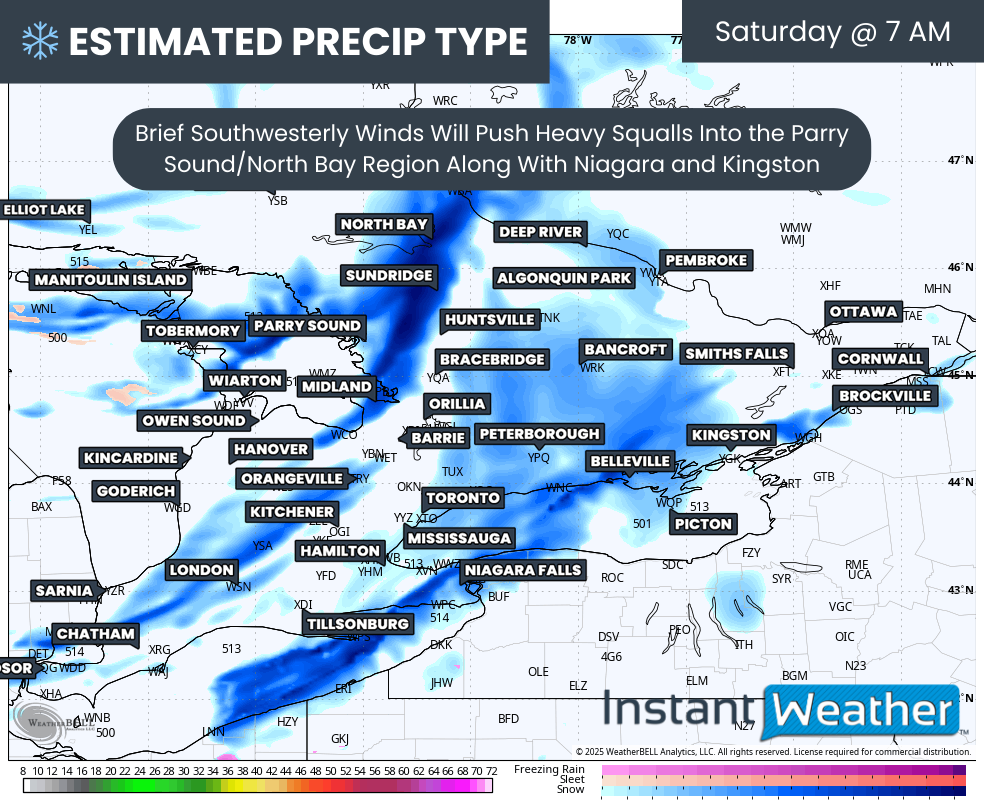
The event is expected to get underway early Saturday morning as a brief southwesterly wind develops. A weak system moving through the region will become enhanced by the lakes, producing short bursts of heavy snow.

This could impact areas northeast of Georgian Bay as well as regions northeast of Lake Erie and Lake Ontario. Places like Parry Sound, North Bay, Niagara and Kingston could see a quick 5 to 10cm early Saturday morning, along with near-zero visibility at times.

Hourly snowfall rates (cm) - MAP FROM WEATHERBELL

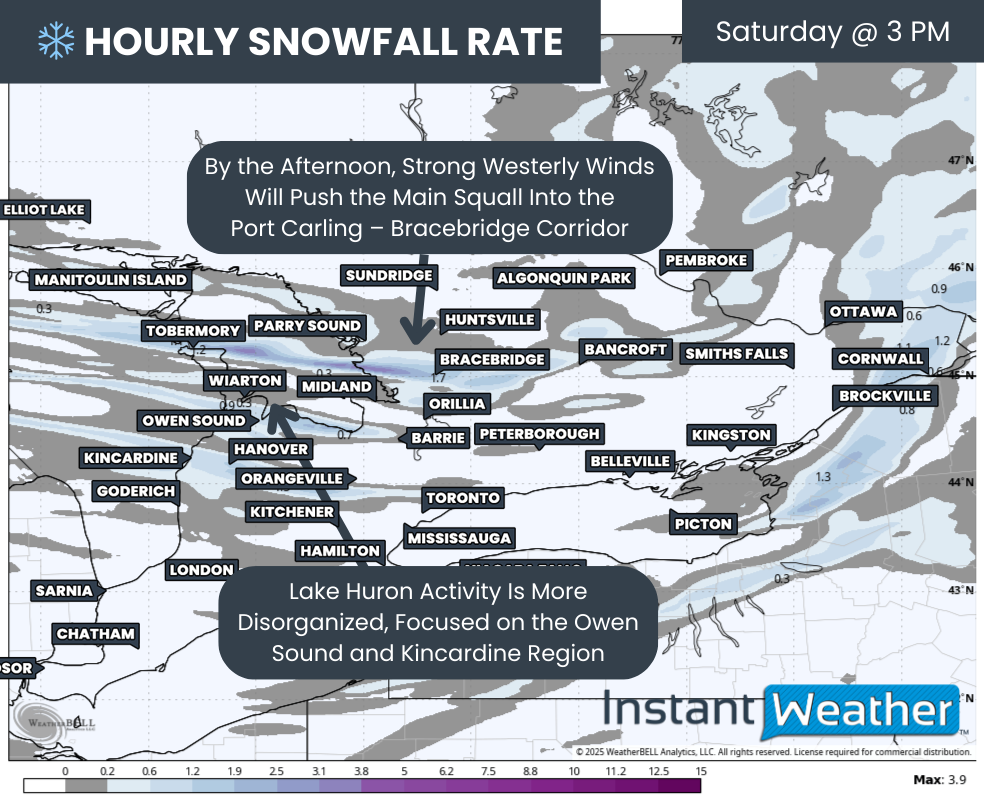
As that system exits, winds will become more westerly, shifting the focus back to Georgian Bay and Lake Huron through Saturday afternoon and evening.

Current model guidance shows a fairly potent and narrow band setting up near the northern tip of the Bruce Peninsula, stretching across Georgian Bay and coming inland near Port Carling and Bracebridge. Keep in mind that even small shifts in wind direction could push the heaviest snow several dozen kilometres north or south.

Very poor to hazardous driving conditions are expected along the Highway 400 and Highway 11 corridors in this area. Highway closures are not out of the question, especially given how quickly conditions can deteriorate.

Additionally, somewhat weaker bands are also expected to develop off Lake Huron, impacting the Owen Sound to Goderich corridor. There remains uncertainty regarding exactly where these bands will set up and whether they consolidate into a more dominant squall.

Hourly snowfall rates (cm) - MAP FROM WEATHERBELL

Later Saturday, a subtle wind shift will cause the main Georgian Bay squall affecting Muskoka to briefly drift south into Simcoe County. This could bring a short period of heavy snow overnight Saturday to Midland, Orillia and Barrie. Accumulation here should be limited, generally around 5 to 10cm, as the squall will be moving through fairly quickly.

A similar evolution will occur east of Lake Huron, with the squall drifting from Tobermory down through the Bruce Peninsula and into southern Bruce and Grey counties overnight. This activity will continue as the squall settles farther south and west of London under a more north-northwest flow.

PRECIP TYPE - MAP FROM WEATHERBELL

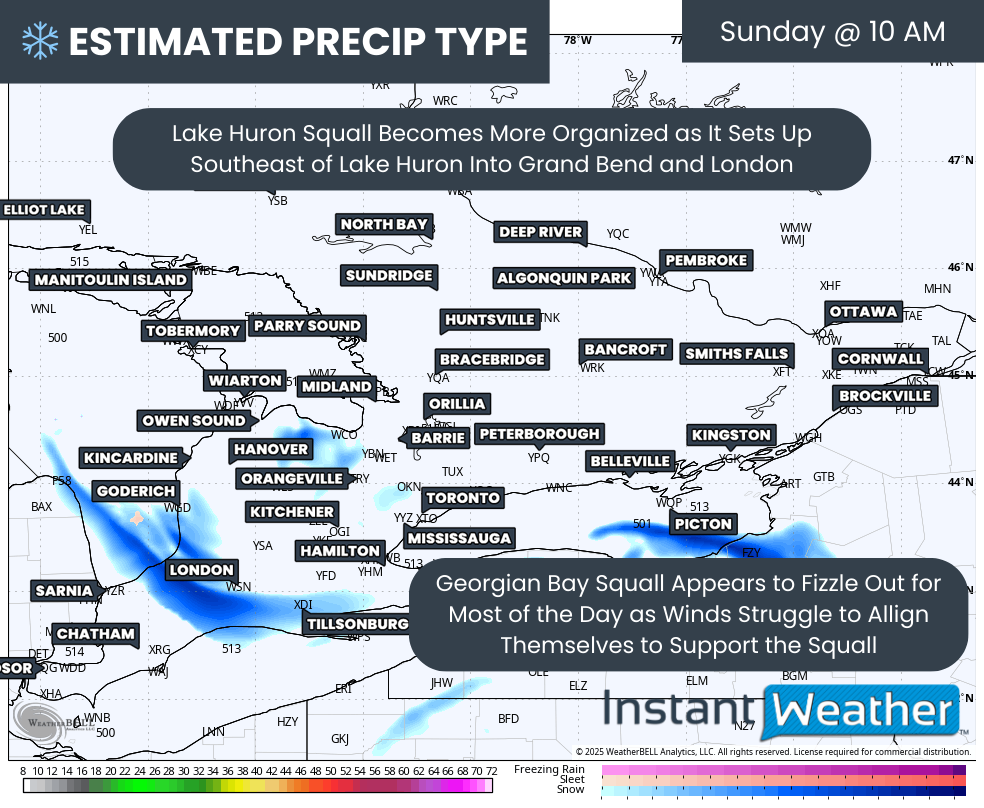
By Sunday morning, the strongest lake effect activity is expected to be found off Lake Huron, affecting the Grand Bend to London corridor. At this point, it appears the core of the squall should remain just west of London, impacting areas like Strathroy, though brief pushes into the city are still possible.

The Georgian Bay squall will temporarily weaken as winds become less favourable for a strong lake fetch. This should restrict activity mainly to shoreline areas near Meaford and Collingwood for a time.

Hourly snowfall rates (cm) - MAP FROM WEATHERBELL

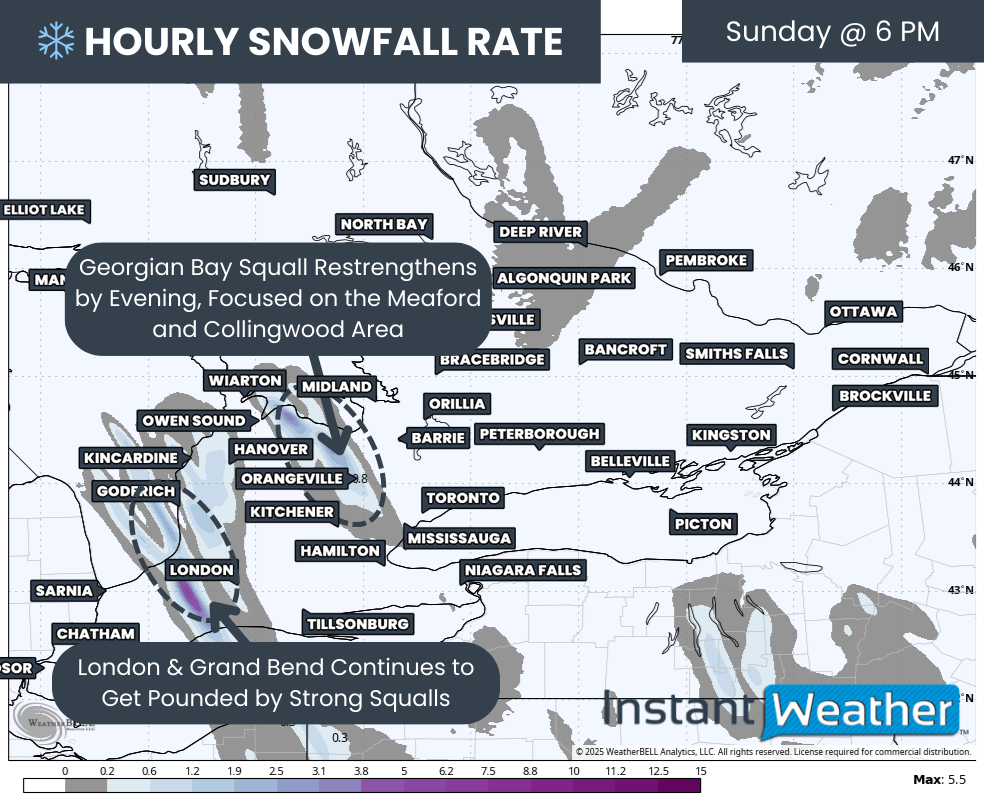
That break will be short-lived. By Sunday evening, increasing winds will allow lake effect snow off Georgian Bay to intensify once again. Some models show moderate to heavy snow developing from Meaford through Collingwood and extending toward the Orangeville region overnight, before the lake effect machine is shut down by an approaching system on Monday morning.

Lake Huron squalls will continue through this time, remaining heavy at times across Huron County, Grand Bend and areas west of London. As with earlier periods, most of the heaviest snow should stay just to the west of the city.

NOTE: YOU CAN CLICK ON THE MAP TO OPEN A ZOOMABLE IMAGE

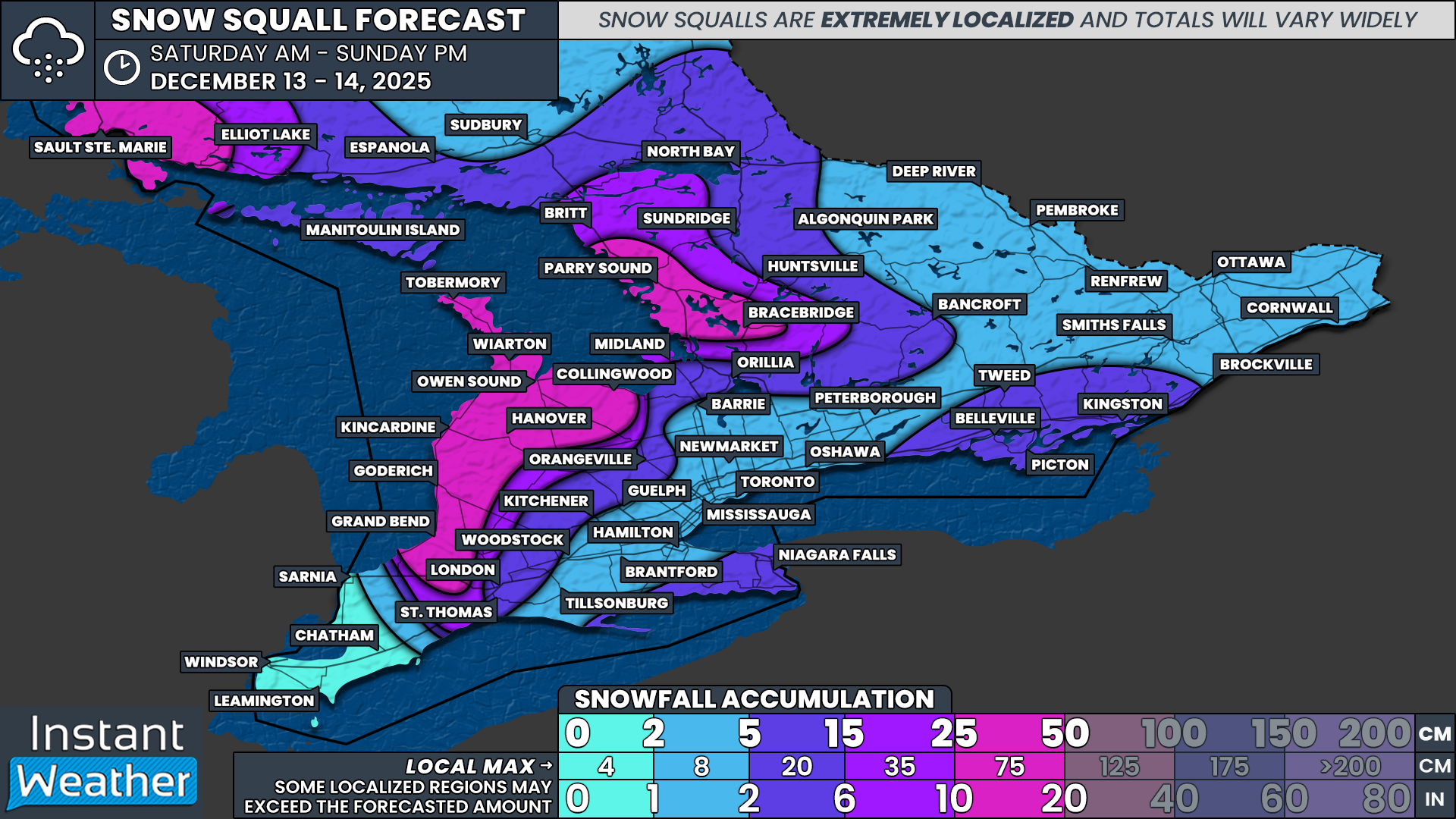
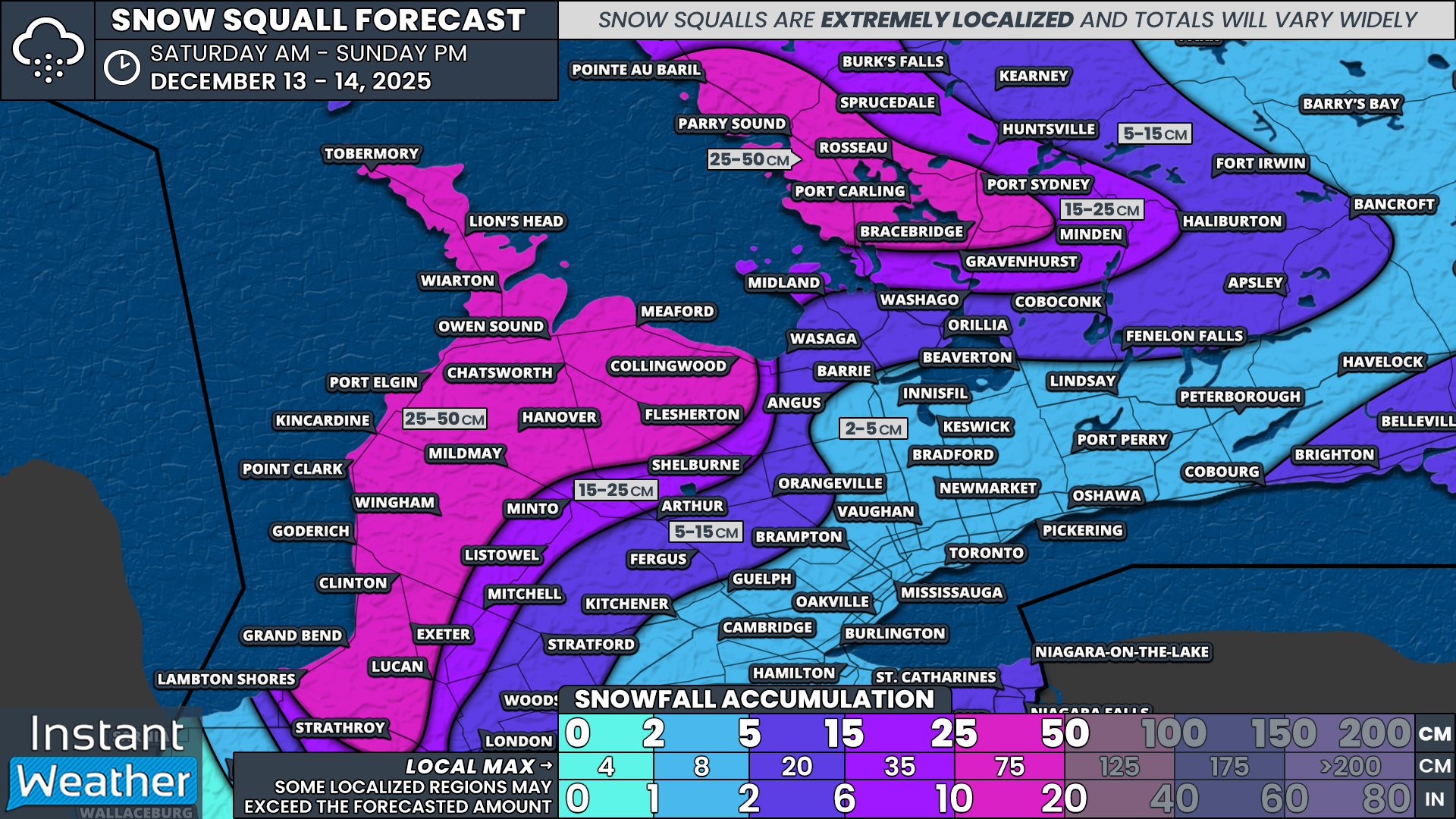
Because the squalls will be shifting around, snowfall will be more evenly distributed across a wider area. We aren’t expecting extremely high localized totals, but many communities will still share in the heavy snowfall. By the end of the weekend, most areas east of Lake Huron and Georgian Bay could see totals ranging from 25 to 50cm.

The usual lake effect disclaimer applies. Some locations will inevitably end up just outside the heaviest bands, but the contrast should be less dramatic this time since most snowbelt areas will be impacted at some point.

The main target zones include areas east of Georgian Bay, such as Parry Sound, Rosseau, Port Carling, Bracebridge and Port Sydney, along with much of Bruce, Grey, Huron and Middlesex counties east and southeast of Lake Huron. This includes communities like Tobermory, Wiarton, Lion’s Head, Owen Sound, Meaford, Collingwood, Flesherton, Hanover, Chatsworth, Port Elgin, Kincardine, Mildmay, Point Clark, Wingham, Goderich, Clinton, Exeter, Lucan, Grand Bend and Strathroy.

Snowfall totals will drop off quickly outside of these regions, as lake effect snow remains highly localized. However, as mentioned earlier, a brief 5 to 10cm is still possible Saturday morning for parts of Niagara and the Kingston area due to lake-enhanced snow from the passing system.

For the rest of Southern Ontario, expect around 2 to 5cm from that system on Saturday, with most locations likely closer to the lower end of that range outside of the snowbelt.

Southern Ontario: ‘Snow Day’ Forecast for Friday, December 12, 2025

NOTE: YOU CAN CLICK ON THE MAP TO OPEN A ZOOMABLE IMAGE

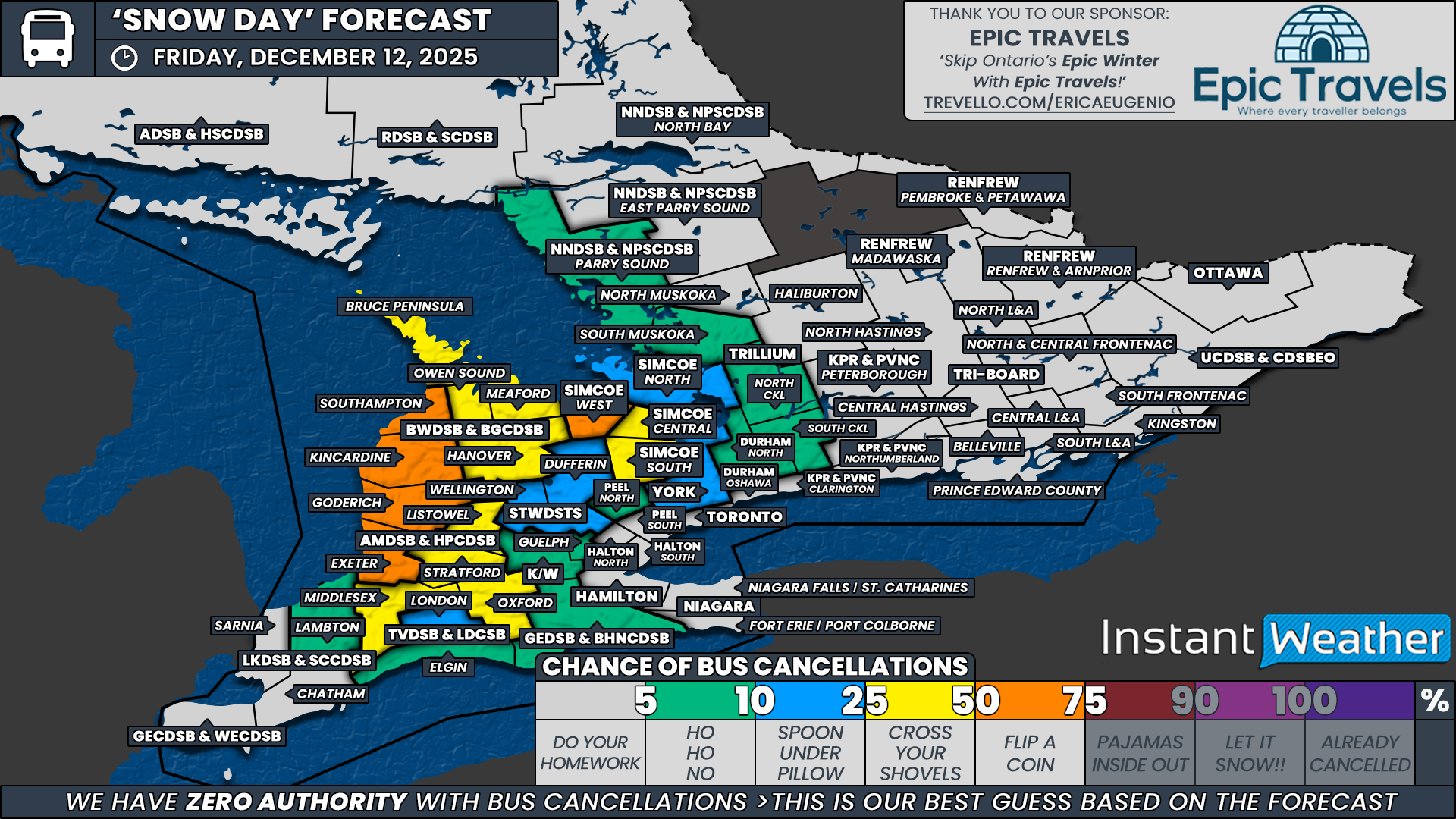
Snow squalls that remained locked in place east of Lake Huron and southeast of Georgian Bay brought a second straight snow day to many students across the snowbelt, with school buses cancelled both Wednesday and Thursday. But for anyone hoping to turn this into a rare three-day streak and stretch the weekend a little further, the chances are not looking nearly as promising.

Through Thursday evening, the squalls have already begun to weaken, with intensity dropping off compared to earlier in the day. That downward trend is expected to continue overnight as winds ease and the lake effect snow machine gradually winds down. By morning, conditions should look much calmer, at least in terms of new snowfall.

However, despite the improvement in weather, many communities have spent the past 12 to 24 hours getting buried in persistent snow squalls. Road crews will be working hard overnight, but in the hardest-hit areas, it is unlikely that every rural route will be fully cleared by the time the morning bus run begins. Even without active squalls on Friday morning, the snow already on the ground may be enough for some school boards to consider keeping buses off the road for a third day.

Confidence in widespread cancellations is not particularly high, so we have capped the maximum at a 50 percent chance. This zone includes Huron County under the Avon Maitland District School Board, southern Bruce County within the Bluewater District School Board, and the Simcoe West zone under the Simcoe County District School Board. These regions experienced the most persistent squall activity today, and their large number of rural routes increases the likelihood that cleanup may not be fully completed by morning.

Outside this core area, a slight chance (25 percent) has been assigned to several surrounding regions. This includes Middlesex and Oxford counties within the Thames Valley District School Board, Perth County for AMDSB, the remainder of Bluewater, including northern Bruce County and all of Grey County, as well as Simcoe Central and Simcoe South. While buses should be able to run in most of these locations, the final decision will depend heavily on how effective overnight cleanup efforts are. Simcoe’s Central and South zones are also more urban, and historically, these areas require more severe conditions before cancellations are considered.

For the remainder of Southern Ontario, a snow day on Friday appears unlikely. Most regions fall into the very low to low category, with no significant weather expected overnight or Friday morning that would normally prompt cancellations. Unless there are unexpected localized issues left behind from today’s squalls, most students should plan for a regular school day.


Disclaimer: Instant Weather has zero authority when it comes to bus and school closures.

It is completely up to the school boards, bus companies, local authorities, and parents to decide what is best for their children. This is our best guess based on our forecast.
Southern Ontario: School Bus Cancellations and Closures for Thursday, December 11, 2025

**Please refresh your page every few minutes to receive the latest update**

Cancellation & Closure Map (English Public and Catholic Schools)

Please note: School board boundaries are a rough estimate. Don’t use this map to determine what school board or weather zone you live in as accuracy isn’t guaranteed.

  • Green = No Cancellations

  • Red = Cancellations (Click for More Details)

  • Purple = School Closures (Click for More Details)

List of Cancellations & Closures

English Public and Catholic Schools

  • Avon MaitIand Public & Huron-Perth CathoIic: There are multiple closures/cancellations, please visit this link for more details: https://hpsts.mybusplanner.ca/Alerts

  • BIuewater Public & Bruce-Grey Catholic: All busses are cancelled.

  • Kawartha Pine Ridge Public & Peterborough Victoria Northumberland Clarington Catholic: all busing and school transportation is cancelled today for all of the STSCO jurisdiction

  • Renfrew County Public & Renfrew County Catholic: Zone 4 Madawaska area transportation services ONLY are cancelled due to observed poor road conditions.

  • Simcoe County Public & Simcoe Catholic: Busses are cancelled for the West, Central, and South Zones.

  • Thames Valley Public & London CathoIic: Busses are cancelled and schools are CLOSED for Middlesex, Oxford, and Elgin Counties, and Red Zone.

  • Tri-Board: transportation is cancelled in North Hastings, Centre Hastings, North Lennox & Addington, Central Lennox & Addington, North & Central Frontenac and South Frontenac weather zones today.

  • Upper Canada Public & Eastern Ontario CathoIic: All transportation is cancelled due to forecasted severe weather and road conditions.

French Schools

  • Conseil des écoles publiques de l’Est de l’Ontario (CEPEO): Busses are cancelled for Brockville, Carleton Place, Arnprior, Prescott-Russell, Marionville, and Merrickville & Kemptville

  • Conseil catholique MonAvenir: Busses are cancelled for schools in Simcoe and Peterborough

  • Conseil scolaire de district catholique de l'Est Ontarien (CSDCEO): All busses are cancelled

  • Conseil des écoles catholiques de langue française du Centre-Est: Busses are cancelled for Brockville, Carleton Place, Arnprior, Prescott-Russell, Marionville, and Merrickville & Kemptville

  • Conseil scolaire catholique Providence: Busses are cancelled for Simcoe West, Central, and South Zones, Oxford, Middlesex rural routes, and Bruce-Grey

  • Conseil scolaire Viamonde: Busses are cancelled for Simcoe West, Central, and South Zones, Oxford, Middlesex rural routes, and Bruce-Grey

Barrie Area to Be Buried in Up to 40 to 75 cm of Snow on Thursday as Arctic Air Fuels Dangerous Snow Squalls

NOTE: YOU CAN CLICK ON THE MAP TO OPEN A ZOOMABLE IMAGE

Snowfall from the Alberta Clipper that slid through Southern Ontario earlier on Wednesday is beginning to taper off. The system has left its mark across the region with a widespread 10 to 20cm of snow in some areas, while others saw a slushy mix.

While the clipper may be done, the snowfall story is not. As the system pulls away, it ushers in a polar blast of cold air overnight on Wednesday. This air, combined with strong northwesterly winds, will kick the lake effect snow machine back into gear off Lake Huron and Georgian Bay.

Intense snow squalls across Simcoe, Huron and Perth counties throughout Thursday are likely to create dangerous conditions. Frigid wind chills paired with near-zero visibility will make travel extremely difficult and even life-threatening if you become stranded.

The Georgian Bay squall is expected to be particularly intense. A narrow corridor from Wasaga Beach through southwest Barrie, including Angus, Innisfil and into Bradford, may see the band lock in place for more than six hours. Snowfall rates could exceed 5cm per hour.

Localized totals around the Barrie area could approach 50 to 75cm in the hardest hit pocket. Some high resolution models even suggest 100cm is not completely off the table.

East of Lake Huron, activity will be persistent from Thursday morning through the evening. The lake effect here appears more spread out rather than focused on one specific pocket. The heaviest totals are expected across Huron and Perth counties, where up to 50cm is locally possible.

PRECIP TYPE - MAP FROM WEATHERBELL

As of Wednesday evening, we are already seeing some activity begin ramping up off the southeast shoreline of Lake Huron and Georgian Bay. This will continue to organize after midnight into the early hours of Thursday.

By early morning, we expect the most focused squalls to target the Goderich to London corridor off Lake Huron and the Collingwood to Bradford stretch off Georgian Bay.

Keep in mind, this is a rough idea from the models, and the exact placement can shift if the wind direction changes even slightly.

Hourly snowfall rates (cm) - MAP FROM WEATHERBELL

By the time the morning commute begins around 6 AM, snow squall activity will intensify as the Georgian Bay band becomes extremely narrow and focused. Some model runs have it stretching from Wasaga Beach through Angus and into the Innisfil to the Newmarket area.

There remains uncertainty in how much snow the City of Barrie itself will receive. The gradient between limited snow and a huge dumping will be very tight. The south and west ends are most likely to see major impacts, although it would not take much of a shift for the band to slide directly into the city.

The Lake Huron activity will begin to spread out with moderate snowfall covering much of Huron and Perth counties, including Goderich, Wingham, Stratford and Listowel. Because the band is more diffuse, there will not be one intense pocket as we expect with the Georgian Bay squall.

ESTIMATED WIND CHILL - MAP FROM WEATHERBELL

A major factor with this round of squalls that makes the situation more dangerous is the very cold wind chills. When you wake up Thursday, wind chills will make it feel like the -20s. Combined with squalls at the same time, the risk to anyone stranded on the roads increases significantly.

Aside from the cold creating hazards, it will also boost snowfall rates. Colder air produces drier, fluffier snow, which allows the same amount of moisture to create a larger volume of accumulation.

Hourly snowfall rates (cm) - MAP FROM WEATHERBELL

Little will change heading into the late morning as the Georgian Bay squall remains locked in place near the Barrie area. The band could edge far enough north to put the city core into the bullseye. Keswick may also be brought into the heavy snow as the band wobbles.

For the Lake Huron squall, the band may briefly become more focused as a single strong line cutting through Goderich and into Stratford and Woodstock. Depending on slight track shifts, Kitchener or Hamilton could also be affected at times.

Hourly snowfall rates (cm) - MAP FROM WEATHERBELL

Conditions are expected to deteriorate further into the afternoon. The Georgian Bay squall appears to strengthen with hourly snowfall rates easily exceeding 5cm and possibly pushing 10cm. At this point, the most intense pocket is shown just southwest of Barrie, with Angus being hit hardest.

The Lake Huron squall will also become more organized with an impressive fetch stretching all the way toward Lake Erie and impacting Woodstock and Norfolk.

Hourly snowfall rates (cm) - MAP FROM WEATHERBELL

There is significant concern for the Hwy 400 corridor during the afternoon and evening commute from just south of Barrie to roughly Aurora. This section of highway will likely become snow covered with road crews struggling to keep up with extreme snowfall rates. Combined with whiteout conditions, travel in this zone should be avoided unless absolutely necessary.

Hourly snowfall rates (cm) - MAP FROM WEATHERBELL

As we head into the evening and just past midnight, the squalls will retreat closer to the lakeshores as winds weaken and moisture supply cuts off. This will lead to activity tapering to lake effect flurries overnight into Friday morning.

NOTE: YOU CAN CLICK ON THE MAP TO OPEN A ZOOMABLE IMAGE

As always with snow squalls, snowfall forecasts should be taken with a large grain of salt. While models are in good agreement on placement and intensity, nothing is guaranteed as conditions need to align perfectly.

With that being said, we believe the hardest hit zone will be along the southeastern Georgian Bay shoreline from Wasaga Beach through Angus and into northern York Region. Barrie sits right on the edge but could easily end up inside the bullseye. Snowfall totals here are likely to exceed 40cm and may approach 75cm. Around Angus is where models show the strongest signal.

A tight gradient will set up with the north and east sides of Barrie, along with Keswick, Bradford and Collingwood, likely seeing 25 to 40cm of snow.

East of Lake Huron including Kincardine, Minto, Point Clark, Wingham, Listowel, Mitchell, Stratford, Exeter and Goderich, totals of 25 to 40cm are expected. Localized amounts up to 55cm are possible if a squall locks in place for several hours.

Totals of 15 to 25cm are possible for Midland and into central York Region including Newmarket and Aurora as well as Durham Region around Uxbridge. These areas will see occasional bursts of heavy snow near the edge of the main bands.

Southern Bruce and Grey counties along with Wellington County including Arthur and Oxford County may also see 15 to 25cm but totals depend on how far inland the bands extend.

Between 5 and 15cm is possible across the rest of York and Durham Region as well as northern Simcoe County including Orillia, Owen Sound, Shelburne, Fergus, Kitchener, Brantford and London. These locations sit farther from the core activity so most will see closer to 5cm with higher amounts only if a band stretches farther inland.

Less than 5cm is expected outside the snowbelt regions including Eastern Ontario, Deep Southwestern Ontario and the Golden Horseshoe.

‘Snow Day’ Forecast: Snow Squalls May Deliver a Second Snow Day to Some Students in Southern Ontario on Thursday

For an updated list of school bus cancellations & school closures, please visit our live article: https://instantweatherinc.com/article/2025/12/11/bus-cancellations

NOTE: YOU CAN CLICK ON THE MAP TO OPEN A ZOOMABLE IMAGE

As snowfall from the Alberta clipper tapers off across Southern Ontario, attention quickly shifts to the next round of winter weather. Snow squalls are expected to develop off Lake Huron and Georgian Bay as early as Wednesday evening, continuing through the night and into Thursday morning.

These squalls have the potential to create dangerous travel conditions in portions of the traditional snowbelt, including Huron County, Grey-Bruce and Simcoe County. Intense snowfall rates combined with near-zero visibility may make it difficult for rural routes to be cleared in time for the morning commute. Because of this, some regions could be facing the possibility of a second straight snow day on Thursday.

The highest chance for another round of bus cancellations includes Huron County within the Avon Maitland District School Board, the Kincardine area within the Bluewater District School Board and the Simcoe West weather zone under the Simcoe County District School Board.

We have assigned these regions a 75 percent chance. While confidence is fairly strong that conditions will be poor enough to warrant cancellations, these boards have been more hesitant this season, even with strongly worded alerts from Environment Canada. That hesitation keeps this group just below the highest tier.

Surrounding regions sit in our 50 percent category, where conditions could genuinely go either way. This includes Middlesex and Oxford counties within the Thames Valley District School Board, Perth County under AMDSB and the Hanover, Southampton and Meaford areas within Bluewater. It also includes the Simcoe Central and Simcoe South weather zones. For these regions, much will depend on where the most persistent squalls set up Thursday morning. Given how lake effect snow can shift quickly, confidence stays right in the middle.

We have also assigned a 50 percent chance to parts of Eastern Ontario, including North Hastings, North Lennox and Addington and North and Central Frontenac within Tri-Board Student Transportation Services. The Madawaska zone within the Renfrew County District School Board also sits at 50 percent. Snow from the Alberta clipper may linger long enough to leave rural roads snow-covered into the morning, and these school boards tend to be more sensitive to deteriorating conditions.

A broader 25 percent zone covers the remaining rural portions of Eastern and Central Ontario. This includes the Upper Canada District School Board, the rest of the Renfrew County District School Board, the southern portions of Tri-Board, Peterborough County within the Kawartha Pine Ridge District School Board and regions covered by the Trillium Lakelands District School Board.

Snow should be wrapping up well before the bus run, but with temperatures dropping overnight and the potential for icy patches, we cannot completely rule out a few isolated cancellations. It remains questionable, but still possible.

We have also assigned a 25 percent chance to some snowbelt-adjacent communities that may be brushed by squalls at times but are expected to remain outside the core impact zone.

This includes Owen Sound and the Bruce Peninsula within the Bluewater District School Board, Dufferin County under the Upper Grand District School Board, the York Region District School Board and the Simcoe North weather zone. Occasional bursts of heavier snow are possible, but sustained conditions leading to cancellations are less likely.

Elsewhere across Southern Ontario, most school boards fall into the very low to low category. A few urban boards may keep a slight chance simply to account for any delays in overnight cleanup from Wednesday’s storm, but given that these same boards did not cancel on Wednesday, it is very unlikely they will decide to cancel on Thursday.


Disclaimer: Instant Weather has zero authority when it comes to bus and school closures.

It is completely up to the school boards, bus companies, local authorities, and parents to decide what is best for their children. This is our best guess based on our forecast.

Southern Ontario: School Bus Cancellations and Closures for Wednesday, December 10, 2025

**Please refresh your page every few minutes to receive the latest update**

Cancellation & Closure Map (English Public and Catholic Schools)

Please note: School board boundaries are a rough estimate. Don’t use this map to determine what school board or weather zone you live in as accuracy isn’t guaranteed.

  • Green = No Cancellations

  • Red = Cancellations (Click for More Details)

  • Purple = School Closures (Click for More Details)

List of Cancellations & Closures

English Public and Catholic Schools

  • Avon MaitIand Public & Huron-Perth CathoIic: There are several closures/cancellations, please visit this link for more details: https://hpsts.mybusplanner.ca/Alerts

  • BIuewater Public & Bruce-Grey Catholic: All busses are cancelled.

  • Dufferin-PeeI Catholic: Buses to St. Andrew, St. Peter, St. Benedict AND in STOPR Zone 3 including ALL buses to Robert F. Hall CSS are cancelled today

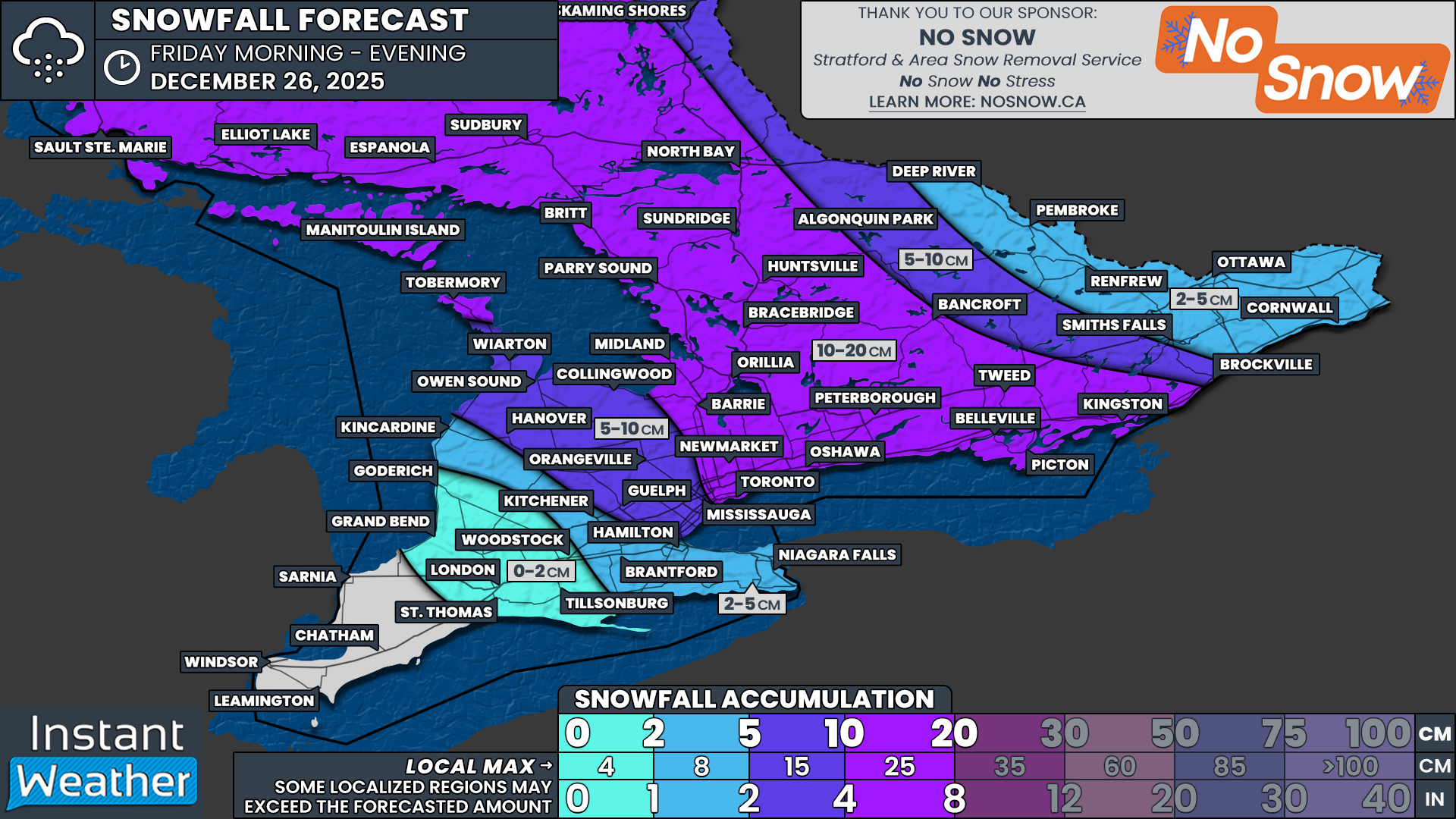
  • Durham Public & Durham Catholic: DSTS has cancelled all transportation for today due to inclement weather.

  • Greater Essex Public & Windsor Essex CathoIic: All Board Provided Transportation is Cancelled for the day for County of Essex

  • HaIton Public & Halton Catholic: transportation services in Zone 2 and Zone 3 are cancelled for the day.

  • Kawartha Pine Ridge Public & Peterborough Victoria Northumberland Clarington Catholic: busing and school transportation is cancelled today.

  • Lambton Kent Public & St. CIair Catholic: Busses cancelled in all zones today.

  • Near North Public & Nipissing-Parry Sound CathoIic: School Bussing is cancelled in the Weather Zones of West Parry Sound and East Parry Sound South

  • PeeI Public: All Transportation in Zone 3 (Caledon) is cancelled today.

  • Renfrew County Public & Renfrew County Catholic: Transportation services are CANCELLED for ALL AREAS Wednesday December 10th, 2025 due to forecasted snowfall amounts throughout the day.

  • Simcoe County Public & Simcoe Catholic: All busses are cancelled.

  • Thames Valley Public & London CathoIic: Busses are cancelled for Middlesex, Oxford, and Elgin Counties, and Red Zone. Schools in the Middlesex, Oxford, and Elgin are CLOSED.

  • Tri-Board: Due to significant snowfall expected across our region, all school bus and taxi transportation is cancelled in the Tri-Board Student Transportation Services area today.

  • Trillium Lakelands: All school vehicles to schools in all Zones for Trillium Lakelands District School Board have been cancelled.

  • Upper Canada Public & Eastern Ontario CathoIic: All transportation is cancelled due to forecasted severe weather and road conditions.

  • Upper Grand Public & Wellington CathoIic: All busses are cancelled.

  • WaterIoo Public & WaterIoo Catholic: All busses are cancelled.

  • York Public & York Catholic: all school bus and taxi transportation serving the York Region District School Board and the York Catholic District School Board has been cancelled region-wide for today

French Schools

  • Conseil des écoles publiques de l’Est de l’Ontario (CEPEO): All busses are cancelled EXCEPT for the City of Ottawa.

  • Conseil catholique MonAvenir: Busses are cancelled for schools in Wellington, Simcoe, Peterborough, and Halton

  • Conseil scolaire de district catholique de l'Est Ontarien (CSDCEO): All busses are cancelled

  • Conseil des écoles catholiques de langue française du Centre-Est: All busses are cancelled EXCEPT for the City of Ottawa.

  • Conseil scolaire catholique Providence: Busses are cancelled for Essex, York, SImcoe, Oxford, Middlesex, Lambton, Kitchener-Waterloo, Halton (Zones 2 & 3), Durham, Chatham-Kent, and Bruce-Grey

  • Conseil scolaire Viamonde: Busses are cancelled for Essex, York, SImcoe, Oxford, Middlesex, Lambton, Kitchener-Waterloo, Halton (Zones 2 & 3), Durham, Chatham-Kent, and Bruce-Grey

  • Le Conseil scolaire public du Nord-Est de l’Ontario (CSPNE) & Conseil scolaire catholique Franco-Nord: School Bussing is cancelled in the Weather Zones of West Parry Sound and East Parry Sound South

‘Snow Day’ Forecast: Many School Bus Cancellations Likely Across Southern Ontario on Wednesday as Clipper Threatens to Dump Up to 20cm of Snow

For an updated list of school bus cancellations & school closures, please visit our live article: https://instantweatherinc.com/article/2025/12/10/bus-cancellations

NOTE: YOU CAN CLICK ON THE MAP TO OPEN A ZOOMABLE IMAGE

A strong Alberta clipper is expected to track across Southern Ontario overnight and into Wednesday. This system will bring a widespread area of heavy snowfall along with pockets of blowing snow that may significantly reduce visibility during the morning and afternoon hours.

Environment Canada has issued broad snowfall warnings ahead of the system, highlighting the potential for hazardous travel conditions throughout the day. With the most intense snowfall expected during the key morning commute window, many school boards, especially in rural regions, are likely to consider cancelling buses for Wednesday.

The highest confidence for a snow day lies across the Parry Sound and West Parry Sound regions within the Near North District School Board, along with Peterborough County under the Kawartha Pine Ridge District School Board and all regions covered by Tri-Board Student Transportation Services. These school boards have a well-established track record of cancelling when Environment Canada issues any form of winter weather warning. Because of this, we have assigned them a 90 percent chance of bus cancellations.

A large swath of Southwestern, Central and Eastern Ontario follows closely behind with a 75 percent chance of a snow day. This includes the Greater Essex County District School Board, all of the Lambton Kent District School Board, Middlesex County within the Thames Valley District School Board and both Huron and Perth counties under the Avon Maitland District School Board.

It also includes the full Bluewater District School Board, Wellington and Dufferin under the Upper Grand District School Board, Simcoe West and Simcoe North within the Simcoe County District School Board, all of the Trillium Lakelands District School Board, Northumberland County for KPR, and the full Renfrew County and Upper Canada District School Boards.

We expect most of these boards to cancel buses, although there remains a small possibility that a few may choose to operate. Snowfall amounts of 10 to 20 cm sit right on the line where some boards become hesitant, and this season, we have seen several take a stricter approach to cancellations. That uncertainty keeps this group slightly below the 90 percent tier.

For many of the province’s more urban school boards, the picture becomes less clear. These include Ottawa under the Ottawa Student Transportation Authority, Barrie and surrounding communities within Simcoe Central and Simcoe South, northern portions of the Durham District School Board, Guelph within the Upper Grand District School Board, northern Halton under Halton Student Transportation, Waterloo under Student Transportation Services of Waterloo Region, and parts of the Thames Valley District School Board covering Oxford County, Elgin County and the City of London.

Urban boards tend to require closer to 15-20 cm of snow on the ground before cancelling, and the clipper’s expected totals may fall just shy of that threshold in some neighbourhoods. Because of this, we expect roughly half of these boards to cancel and half to continue running.

For the Greater Toronto Area, confidence drops even further. Environment Canada has opted to issue a special weather statement rather than a snowfall warning, and the potential for mixing may limit totals during the morning commute. These boards, including Durham South, York Region, Toronto, Peel Region, southern Halton and Hamilton, along with Niagara, tend to be the strictest in the province when it comes to cancellations due to their lower reliance on bused students.

Here, the chance of a snow day ranges from around 10 percent in Toronto to up to 25 percent in the surrounding boards. Surprise cancellations are not impossible, but the overall lean is toward buses running.


Disclaimer: Instant Weather has zero authority when it comes to bus and school closures.

It is completely up to the school boards, bus companies, local authorities, and parents to decide what is best for their children. This is our best guess based on our forecast.